Friday, November 21, 2008

Another Amateur Roulette Cheat Team Busted In Seattle Casino Chip-Coloring-Up Scam


Three men were charged with cheating the new Snoqualmie Casino, and if you ask me, I wouldn´t be able to tell you a more ridiculous roulette cheat scam, but they still managed to get up $1,500 before the rookie surveillance staff caught on.

King County prosecutors have filed charges against three New York men accused of trying to fleece the newly opened Snoqualmie Casino. Jorge A. Acosta, Jose Peralta-Yapor and Marcos Peynado were arrested at the North Bend casino Nov. 10, four days after the tribe-owned facility opened. Prosecutors have since charged all three men with first-degree cheating, a felony that carries a maximum sentence of five years in prison. According to court documents, casino security spotted a group of six men trying a well-known cheating scheme at one of the casino's roulette tables. One member of the group bought roulette chips at $1 each and then surreptitiously pocketed some chips from the table while playing. He then left the table with dozens of chips hidden in his pocket. That player then met a second player elsewhere in the casino and handed off the chips. The second player returned to the table, bought chips of the same color at $25 each, and later cashed out the stolen chips at the higher value after playing.

Unlike poker or blackjack chips, roulette chips have no set dollar value. Instead, a dealer sets the chip value when a player joins the game. Police estimate the group of men was able to steal about $1,500 from the casino in less than an hour.
According to police, Acosta, Peralta-Yapor and Peynado were helping three other men in the scam. The other men are not named in charging documents. Acosta, 30, and Peynado, 26, were released from jail after posting bond. Peralta-Yapor, 28, remains in custody.

Thursday, November 20, 2008

Was 2008 WSOP Final Table Cheat-Free?


The 2008 WSOP Main Event Final Table…completely legit? Or was there a little hanky-panky going on? Well, I’ll let you be the judge, but after reading this article you might have a rather strong opinion in one direction.

Let’s look at the most important element in creating not only a WSOP Final Table cheating scam, but any scam, that is “time.” The greater the period of time, the more time there is not only to plan scams but to practice them, improve them and perfect them. So how does this relate to the final table of the 2008 WSOP that played out last month on ESPN and other cable networks across the world? Well, there were exactly 114 days separating the last day of play that determined the final table and the start of play at that final table itself. That, my poker reading friends, is lots of time.

Before I get into possible and probable cheating scenarios at the WSOP, let me get one thing straight: all those pre-final table statements made by Harrah’s officials that they would watchdog every integral element of the WSOP to ensure the integrity of the tournament and that no cheating would be tolerated as long as their gaming empire hosted the WSOP are worth about as much as the CD I wrote this article on…unless, of course, Harrah’s employed the FBI and Scotland Yard to conduct 24 hour surveillance not only on the nine participants at the final table but all their friends and families as well, not to mention anyone else who might be connected to the players or the tournament, and this for a duration of 114 days.

What I am saying is that there is no way Harrah’s or WSOP officials would ever be able to ensure a cheat-free final table, and I will also say that they really don’t care. Why? Well, if they cared, they never would have permitted a 114-day break between the last day of play and the next day of play. It is clearly obvious that the reason Harrah’s and the WSOP organisers changed the main event format was to milk out as much publicity and exposure as they could, which results in more money for sponsors, TV and cable networks, and, of course, Harrah’s and the WSOP itself. The entire scenario is reminiscent of another one that never took place. If you remember, back in 2006, the American Cable Network Fox Sports Net attempted to run with the giant ball that was supposed to be a series of six-player winner-take-all freeze-out tournaments for $60 million in 2006, then for $75 million in 2007 and $100 million in 2008. At the time, this was the greatest poker hype ever attempted, but finally Fox Sports Net realised that it couldn’t convince the public that six players were each going to put up $10 million of their own money to play against players of equal calibre to themselves. I had even predicted in my book “Dirty Poker” that the giant freeze-out would never take place because it was basically a fraud, and sure enough it was cancelled.

So, what possibly and probably happened at the 2008 WSOP Main Event Final Table? Well, I am going to combine the two: what possibly and very probably happened was massive collusion and deal-making. There was simply too much money, and more important, too much time for it not to happen. What makes this scenario so glaringly probable is that there was no dominant chip-leader going into the final table the way there was back in 2006 when Jamie Gold, the eventual winner and accused “deal renegger,” had a commanding chip lead that he turned into a championship and $12 million in his pocket (minus whatever amount he finally gave his backer that he tried to stiff). With nearly all the nine players very much in the hunt at the start of play, and only one short stack, the collusion cheating opportunities were endless. In fact, if you take all the possibilities and combinations of any or all of the nine players entering into prearranged prize-money-sharing, there are more than a million different ways to cut up the giant cake! In other words, there could have been cheating twosomes, threesomes, foursomes, fivesomes, sixsomes, sevensomes, eightsomes…and even ninesomes, although maybe the first eight players might choose not to involve the ninth in any deals given his short stack, but who knows?

Is there a possibility that none of the above scenarios happened and there were no prearranged deals or anything else resembling collusion play? Sure there is, but it’s about as slim as the possibility that we will never again see an online poker cheat scam. If anyone could relate to this theory and back it up, it might be ex-WSOP Main Event Champ and accused mastermind of the $60 million UltimateBet online poker scam Russ Hamilton. He was the main-event winner in 1994, and he probably could wipe out that “slim” with testimony to his own experiences at the WSOP final table. In any event, I could hardly imagine, and I doubt you could too, that 114 days are going to pass without conspiring, scheming, planning and everything else that leads to cheating. Just think of all that time these nine players—okay, let’s even include the poor guy in ninth place with the tiny stack—had to communicate.

Are you wondering how they might have communicated? Well, try this on for scenarios: it starts with simple e-mails, then steps up to instant messaging, then phone calls and then…well, why not a pre-final table final table? No, it’s not a typo! What I’m talking about is a meeting of all nine players around an oval table in a cozy restaurant or lounge, maybe like the Peppermill on the Las Vegas Strip, the same cozy lounge that I often used with my cheating buddies to map out strategies for hitting the casinos on the Strip. There, the “lucky nine” could sip champagne while relishing in thoughts of the money they KNEW they would be receiving on that glorious November day to come…Okay, well…maybe the lucky nine wouldn’t be brazen enough to meet in a public place like that but they could have rented a suite at the Bellagio and snuck up to it unnoticed and had the champagne sent up by room service. However they chose to do so, 114 days is lots and lots of time to plan and scheme.

And if you think for one minute that this could not happen, then you probably spend half your life watching ESPN and other cable network poker broadcasts!

Wednesday, November 19, 2008

Has Gambling Cheating Online Surpassed Brick and Mortar Cheating?


Believe it or not, and in spite of all the online poker and casino cheating news you’ve been hearing and reading, online gambling cheating has not yet surpassed brick and mortar poker and casino cheating. In fact, it is still way behind. Because of the giant press the UltimateBet and Absolute Poker online cheating scams have been getting, and of the alleged involvement of ex-WSOP champ Russ Hamilton, as well as the current final table of the 2008 WSOP Main Event and the much anticipated broadcast of CBS’ “60 Minutes” segment covering the online cheat scams, brick and mortar cheating has been getting little coverage—in spite of the fact that it goes on every day in numerous locales throughout the gambling world. As I write this article, Russian brick and mortar poker cheat teams are circulating widely throughout Europe and have penetrated London’s poker rooms. They mainly work collusion and card-swapping scams, and I have even heard reports that they have gotten into laser card-marking operations, which would no doubt be the most dangerous (and lucrative for them) brick and mortar poker room scam yet seen. More Russian high-tech casino cheating teams are also operating in both Europe and the US, targeting roulette tables, where with their gadgetry they have the ability to accurately predict in what sections of numbers the ball will land…Macau continues to be prey for Asian casino cheat gangs who specialize in baccarat scams. Despite Macau boasting its state of the art casino surveillance rooms and top-shelf personnel, below, on their gargantuan casino floors, they are getting cheated out of tens of thousands of $ every day…In Las Vegas and Atlantic City, roulette pastposters and slot cheat teams with inside help are operating fruitfully…Connecticut casinos, now 16 years old and boasting the largest revenues in the world despite Macau’s massive casinos, continue to be the haven for casino dealers who want to rip off the casinos they work in. As has been its history, casino surveillance in Connecticut is weak and very late catching onto table gams scams and cheats. The only reason you hear so much about cheats getting busted in Connecticut casinos is because there is so much of it going on that you don’t hear about. Remember, only those busted make the news…In Mississippi, cheats are also thriving, especially in the poker rooms where good ol’ American cheat teams are colluding suckers out of there money…Surprisingly, I have not been getting that many reports about cheating in California’s casinos and cardrooms, with the exceptions of the Barona and Sycuan casino resorts near San Diego, where surveillance continues to be weak despite my participation in a Game Protection Seminar at the Barona casino in September, 2007. While there I noticed some really easy cheating opportunities in its gaming pits, especially at roulette and the poker carnival games.

So for you online players worried about online cheating and thinking of turning off your computer and heading to your local brick and mortar casino, think again!

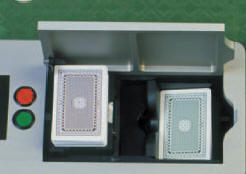
Can ShuffleMaster Automatic Card Shuffle Machines Cheat You?


I have recently received several e-mails asking me about Shuffle Master’s automatic card-shuffling machines, mainly whether or not they can be manufactured to cheat by Shuffle Master itself by way of performing false shuffles or fixed shuffles, and whether casino personnel can manipulate the card shuffling machines in order to cheat blackjack, poker and baccarat players. Some of these writers expressed complaints about suspicious deals they witnessed and attributed to the Shuffle Master card shufflers.

Well, let’s take a look at this question in two parts. First: Could Shuffle Master itself produce card shuffle machines that cheat for casinos against the players? The answer is, of course they could. But they would need cooperation from casino personnel using their machines on blackjack and poker tables, where a big conspiracy would have to take place. In blackjack, this could be done by dealers looking to isolate clumps of 10-value cards and Aces, which they would keep away from players by placing them within the clump of cards behind the cut card that never gets dealt. Keeping those cards away from card counters as well as normal players would give the casino a substantial added advantage where no one could legitimately beat the game in the long run. But would Shuffle Master actually engage itself in a conspiracy with casinos to cheat players? Of course not. About the only way a Shuffle Master shuffling machine would be involved in a “false” or uneven shuffle is by way of a defective machine that just doesn’t properly or effectively shuffle the cards, resulting in clumps that may either benefit the casino or card counters and legitimate players.

But what about casino personnel manipulating the machines in furtherance of a cheating operation, mainly dealers with or without supervisor participation? Yes, this can happen. But it would probably not involve a defective card shuffler. All the dealer would have to do is simply turn off the machine or disable it in some other way. If he were looking to use or hold back a clump of high or low cards for a new shoe that he noticed during the shoe he’d just dealt, he could indeed accomplish this by manipulating the shoe. And this could be done without turning the shoe off. Any person skilled with this type of machinery would be able to tamper with the machines so that they appear to be shuffling completely when they are not. But again, this would take lots of involvement by various employees to avoid the risk of being seen tampering with the machines. I mean, after all, as the entire casino floor today is monitored by surveillance cameras 24/7, any “work” done on the Shuffle Master card shuffle machines would be recorded by surveillance cameras, thus surveillance personnel would have to be in on any scam.

Bottom line: I don’t think there is any risk worth worrying about as far as being a victim to a Shuffle Master cheating card shuffle machine.

Sunday, November 16, 2008

PokerSoftware.com Makes Play To Stop Online Cheats!

PokerSoftware.com Publishes Guidelines for Determining Legitimate Poker Software.

PokerSoftware.com is quickly becoming the go-to destination for poker players looking for answers on which poker software programs are legitimate and which are rip-offs amid the wide variety of poker software available nowadays.

San Jose, Costa Rica (PRWEB) November 15, 2008 -- Poker software news site PokerSoftware.com has received an onslaught of questions regarding the legitimacy of many programs that its members have run across. The poker software industry is still young. Like the poker world, it began to explode when little-known Tennessee accountant Chris Moneymaker won the 2003 World Series of Poker Main Event, vaulting poker to its place as the true American pastime. Now, poker software exists that can keep track of a player's results as well as that of his opponents. Other pieces of software reveal real-time odds and can aid players when selecting a table. PokerSoftware.com has taken the time to review over 50 of the world's most popular programs in order to give users an in-depth look at the pros and cons of each.

Although online poker rooms differ in their acceptance of certain types of poker software, each legitimate program is backed by a team of customer support personnel and technical specialists. Poker enthusiasts never have to guess if a program reviewed on PokerSoftware.com is genuine. Many of the poker software reviews on the site even include a full video analysis of the program, narrated by its team of experts.

However, all is not rosy. The industry, like many others in business, is full of get rich quick schemes. PokerSoftware.com exposed one such poker cheating software explaining why the program could never work at the tables. Still, many players fall prey to these dubious claims every single day. PokerSoftware.com resident expert Chris Wallace recently authored a feature article on the site asking users to exercise caution when purchasing programs that are unfamiliar to them. It has been one of the most popular articles to appear thus far.

If players stumble across new software, they should ask themselves if the program in question is making promises that don't make sense. Why would a person raking in thousands of dollars from the tables every night because he is cheating want to share his secrets for just $50? Second, software enthusiasts should ensure that the site has a forum. If it doesn't, it's an ominous sign for its legitimacy. Potential customers can also use popular search engine Google in order to gauge what has been said about the program elsewhere. Finally, interested buyers should also exercise common sense. If the program makes claims that appear too good to be true, then chances are it is not legitimate.

If in doubt, users of PokerSoftware.com can always post in the poker software forum. The site's staff will check it out and perhaps even review it. If a piece of software is nothing more than a rip-off, PokerSoftware.com will say so.

Thursday, November 13, 2008

UltimateBet And Absolute Poker COO Leggett Admits To Cheating On Both Sites

Absolute Poker and UltimateBet Poker COO Paul Leggett sat down to speak with the CBC (Canadian Broadcast Company) to discuss his company's trying times over the past 10 months. In a candid interview), Leggett fully admits there was cheating on both sites.

"Poker playing has always been marred by cheating scandals," the host points out, explaining further that the cheating scandal uncovered at both Absolute Poker and UltimateBet caused enormous outrage.

Leggett arrived on board at Absolute Poker in late August of 2007, around the same time that the cheating scandal was said to have occurred. Initially he was brought on to help merge both Absolute and UltimateBet onto one platform and to improve customer service as well as marketing.

Joe Norton of Kahnawake Gaming purchased Absolute/UtlimateBet from the original owners. Leggett claims that none of those original owners are still involved with the company.

Leggett explains that the first priority after uncovering the cheating scandal was to ensure those adversely affected were taken care of by his company. The perpetrator, who was someone internal, provided information to this extent as to which customers may have been affected. Leggett says that in exchange for this information, that individual was given protection.

"This is kind of unusual," the host points out. "You're allowed to do that?"

"Well, we can decide if we are going to press charges or not but because we were a victim in this thing our concern was making sure we got the money back and there wasn't a breach from other areas. "

Charges could be filed against that individual by the Kahnawake Gaming Commission at a later date, Leggett said.

Roughly $800,000 was stolen and Absolute was able to recover 100 percent of this money since it remained in the cheater's accounts. Absolute Poker had to pay well over a million to customers, however.

"Everyone got paid out plus," Leggett said. "The brand damage is something we'll be fighting for years."

Thursday, November 06, 2008

New Details Revealed About High-Tech Russian Cheat Team Called The "James Bond Mafia"


That high-tech Russian casino cheating team I have recently written about has been active in Moscow and other casinos in Eastern Europe. In one Moscow casino, their team of Caribbean Stud Poker players had ingeniously hollowed out a stack of 100 dollar chips and incorporated a mini camera with battery, the signal was transmitted using blue tooth technology, in order to read the dealer's cards as they were being dealt from his hands, fortunately the scam was discovered before it even developed legs because the casino itself was deploying equal high tech equipment, in the form of mini camera scanners to discover this type of action. Russians and Ukrainians are leading the cheating world with this type of scam, in an even more recent coup a group of Russians were arrested in a casino in Northern Cyprus; their equipment was so high tech it led the press to dub the scammers the James Bond mafia.

Tokwiro Wins $15 Million Judgment Against Excapsa For Damages In UltimateBet Poker Cheat Scandal!

In the latest twist in the reimbursement of players at Ultimate Bet, a subsidiary of the parent company (Tokwiro) of the online poker room has won a $15 million judgment against Excapsa, a software manufacturer and former owner of the site. The money will now be used by Tokwiro to refund players who were affected by the cheating scandal that rocked the site.

Justice Sarah E. Pepall of the Ontario Superior Court of Justice (Canada) handed down the ruling on Monday. Paul Leggett, the CEO of Tokwiro, commented in a press release distributed by the company on Wednesday, “We are pleased that we have finally agreed to a settlement with the previous owners of Ultimate Bet, and we are happy to announce the completion of the final refunds to players.” The cheating scandal was found to have been commanded by World Series of Poker bracelet holder Russ Hamilton, who was also involved with Ultimate Bet’s affiliate program. In July, one of the questionable accounts was positively linked to a home owned by Hamilton in Las Vegas. The cheating began in May of 2004 and occurred for nearly four years.

To put to bed any allegations that Tokwiro was responsible for the scandal, Leggett added, “Now that the main perpetrator has been named, the settlement with the previous owners is behind us, and players have received refunds, it should now be apparent that Tokwiro had no involvement in this cheating and that we have fought to correct it with every tool at our disposal.” The Kahnawake Gaming Commission (KGC), which is the regulatory body that oversees Ultimate Bet as well as a handful of other popular online poker rooms, hit the company with a $1.5 million fine.

The KGC issued a press release of its own following Monday’s judgment, claiming that Ultimate Bet will shell out around $21 million in refunds to players, consisting of $15 million from the judgment and $6.1 million in reimbursements that have already processed. The KGC originally gave Ultimate Bet until November 3rd to comply, but because of ongoing litigation with Excapsa, the organization will allow its licensee extra time to comply with its mandates. The KGC’s press release states that its “final decision in this matter is expected to be issued once all player refunds have been confirmed.”

Although its litigation against Excapsa is now finished, Leggett implied that additional legal action may be forthcoming: “We continue to reserve the right to pursue further legal action against any individual or individuals involved in stealing from us or our customers.” The wrongdoings at Ultimate Bet and its sister site, Absolute Poker, may among other recent developments be the subject of a feature by CBS news program “60 Minutes.” An air date has not yet been announced. Its show lineups are typically released every Thursday and available on the “60 Minutes” website. Each episode usually consists of three features.

Blast-Off Ltd. was the actual beneficiary of the $15 million in damages. It is owned by Tokwiro and “originally acquired Ultimate Bet” from Exapsa, according to Tokwiro’s press release. In September, MSNBC printed a story stating that a $75 million claim had been filed by Blast-Off.

Meanwhile, the online poker room is gearing up for its third Ultimate Bet Online Championship (UBOC), which kicks off on January 9th and concludes with a $1,050 buy-in $1 Million Guaranteed Main Event nine days later. In the middle of the schedule is a $5,200 buy-in Six-Handed No Limit Hold’em Championship that boasts a $1 million guaranteed prize pool. There are 12 events in total in Hold’em, HORSE, and Omaha. Deep-stack, Sniper, short-handed, and heads-up tournaments will be featured. In 2007, Ultimate Bet members Maria Nuccia and Fred420 each took home $168,450 from the UBOC Main Event.

After All...I Mean All The Cheat Scams and Scandals, Is Online Poker Safe Or Ever Going To Be Safe?

Is online poker safe? Is is safer in the UK than in the US and the rest of the world?
After the UltimateBet and AbsolutePoker cheat scandals rocked the online world, let's see how safe online poker really is.

For years people have filled forums and chat rooms with their crackpot theories about how online poker is fixed. It seems like anybody who’s ever had their Aces cracked or bluff called down has hit the net, telling all and sundry that the online game is rotten to the core.

These conspiracy theories have been shot down by anyone with half a brain, and were refuted by this magazine just a couple of years ago. The evidence against cheating is fairly substantial, but overriding every argument and counter-argument is the big question: why would online operators want to cheat players out of money and risk losing everything, when they make so much money legitimately?

The biggest sites in the business rake in over $1m-a-day profit, so why would they need to cheat you out of your paltry bankroll? Getting more bad beats online? You need to remember that you play lots more hands online, and people play much looser, especially at the lower stakes tables. Still losing and you can’t explain it? Get better at the game...

Smoking gun!

Unfortunately, that sort of explanation doesn’t cut it any more. Not after the smoking gun was found. It emerged that a former employee at Absolute Poker had access to a ‘superuser’ account that enabled him to view his opponents’ hole cards. Poker’s an easy game when you can see all the cards, and using this information, an account under the name Potripper played a ‘perfect’ game and watched the money come flooding in.

The problem was that it flooded in a little bit too quickly and it didn’t take long for the calls with Ten-high and unorthodox pre-flop play to raise warning flags among the online community.

After much speculation, accusation, explanation and denial, a statement was issued by Absolute Poker that cheaters had indeed found a way to see players’ hole cards, and the world of online poker was turned upside down.

Incredibly, while forums were filled to bursting with people saying, "I told you so," a second scandal broke involving sister site UltimateBet. Former employees of the company had placed ‘unauthorised software code’ on the servers, which granted specified accounts the ability to see opponents’ hole cards.

It transpired that for three years these "superuser" accounts had demolished some of the world’s finest players and then mocked them as they counted their winnings. WSOP bracelet winner Todd Witteles was one of the victims. "I personally lost over $15,000to the Absolute Poker cheaters," says Witteless. "The person behind the account wasn’t just satisfied quietly stealing money from the site’s highest limit players – he got some sort of perverse and sadistic enjoyment out of the whole thing, often obnoxiously celebrating his victories and taunting opponents from the rail after beating them and leaving the game."

Safety Second

Both UltimateBet and Absolute Poker had been acquired by Tokwiro Enterprises, which inherited not one, but two cheating scandals. What initially looked like a couple of profitable acquisitions, now promised to stand for everything that was bad in online poker.

Paul Legget, chief operating officer of Tokwiro Enterprises, explains how they set about restoring customer faith in the now tarnished brands and ensured that the same thing could never happen again. "Once Tokwiro discovered the cheating scandals, we reacted with a determination to do everything we possibly could to protect our customers in future, and to reimburse them for their losses in unfair play."

Refunding players that have been cheated and putting in much more stringent safety and security features is one thing but the question posed by many players is, "Why weren’t these security measures in place before?" Why did it take a bunch of internet players to notice irregular betting patterns that should have been picked up by elementary checks online? And how about naming the perpetrators, whose alleged names are being whispered across internet forums the world over?

According to Legget, there’s nothing he’d rather do, but he says the company’s hands are tied. "We’ve collected a massive amount of evidence...key addresses of people who’ve accessed the cheating tool," he said in a recent online interview. "I’m confident in my own mind that I know who the perpetrator is, but unfortunately I can’t just come out publicly and condemn someone – we’re not a court of law and we have to be very careful what we say. Our lawyers have specifically forbidden us to name any names at the moment because we’re involved in very complicated legal action, and we hope this legal action will result in recovering a very substantial amount of money... The perpetrators may come out as a result of the legal action, which would be very satisfying."

It sounds convincing, but is it a classic case of slamming the door shut after the horse has bolted? A lot of players aren’t in the mood to forgive and forget. And why should they, when there are plenty of other places to play? But then that begs the question, are other poker sites any better?

We spoke to Joe Legge, poker product manager at Virgin Poker, which is part of the Boss network. He’s adamant that what happened to Absolute and Ultimate simply couldn’t happen in its games as the hand history is only generated once the hand is settled. This means that hands can be replayed by the fraud and customer service teams after the event, but they can’t access the hands in real time, making it impossible to abuse the system. The world’s biggest online site – PokerStars – says the same.

Rise of the Robots

But even if you can trust the site and its software, what about the external threat? With all the talk of superuser accounts, the threat of "bots" seems to have been forgotten about. But surely as technology improves, the idea of a poker bot, programmed to optimum strategy and hoovering up money night and day, is a recurring worry?

To hammer home the fact, it seems like all you have to do is conduct a simple Google search and you’ll find dozens of companies currently advertising their own poker bots, which they guarantee will clean up online. Slogans such as, "Make $1,500 while you sleep... EVERY NIGHT!!" scream out to attract the gullible, who can’t resist the lure of easy money. You can obviously ignore all of these amateurish commercial offerings. If they actually made money it would make more sense for the developers to keep them quiet and make money from playing. We tested one of the better-known ones – WinHoldEm – back in 2006 and it bust our account overnight. Also, the better known the program is, the more chance that you’ll be detected and have your account closed and assets seized.

Because poker rooms know their future depends on convincing poker players they won’t be competing with super computers, they’ve put lots of resources into the problem.

Stephen Winter, senior manager of PokerStars Game Security, explains, "We recognise the fact players don’t wish to play against bots and we take our responsibility to detect and remove bots very seriously. PokerStars has, without question, the industry’s leading bot detection system. It is to our credit that many bot operators openly advise their users to avoid PokerStars. Dedicated servers are running constantly to detect bot activity, backed up by a team of specialist "bot hunters."

All well and good, but while the poker rooms claim that they detect the majority of bots, it’s still possible to imagine a bunch of MIT students building an undetectable super computer to take the world by storm.

We asked the man behind the University of Alberta’s much lauded Polaris programme if he thought an advanced poker bot could be put together by enthusiastic amateurs. He explained, "Based on our experience, I think anything close to Polaris’s level happening outside an academic institution is unlikely. It’s taken 15 researchers over five years to reach this point. In addition, we’ve made use of various high performance computing resources – for example, months of time on a 30-node computer cluster containing quad-core machines each with 8GB of RAM."

Split Personality

A simpler way to get an edge over your opponents is to play with multiple accounts in the same game. The theory is that in addition to giving yourself multiple chances to win a tournament, you also stand the possibility of having two or more of your accounts ending up on the same table where you can increase your chance of winning.

Several major tournaments have been scooped by people controlling more than one account. In 2006 the online player JJProdigy won the $500k guaranteed PartyPoker tournament and collected the $140,000 first prize. Unfortunately, he won it using a second account he was in control of, and when details of his multi-accounting reached PartyPoker the site suspended both accounts and confiscated a total of $180,000 in winnings.

More recently, other high-profile cases have been uncovered by vigilant online sites, along with instances of players "selling" their tournaments once they’re deep into the money for a better player to finish off. This was the scandal that mired popular online player Sorel Mizzi late last year. It might not seem as blatant a case of cheating, but whether the player has already played or not, it puts the other players at a big disadvantage. Imagine you’ve been playing against someone for a couple of hours when, unbeknown to you, a switch takes place, and you’re suddenly up against a completely different style and one of the best players in the world?

This abuse really hit the headlines when PokerStars caused a massive stir by revealing that the winner of its flagship 2007 WCOOP series and richest online tournament ever, TheV0id, had been disqualified for account irregularities. This case played out in great detail online, and it turned out that the account belonged to Natalie Teltscher, the sister of well-known UK pro Mark Teltscher. Rather than taking it on the chin, Natalie Teltscher decided to chance her arm and take PokerStars to court, effectively forcing the online site to prove its security team could provide detailed and concrete evidence. Thankfully it could, and Teltscher withdrew her case and was ordered to pay PokerStars’ legal costs. All of these high-profile cases prove that players playing multiple accounts is a problem, but it also proves the top sites are on the case, and won’t let players get away with it – even if it means dragging its name through the courts.

Collaboration

Which brings us to the problem that most online players in the know are concerned about: collaboration. People communicating their hole cards through instant messaging or over the telephone can prove to be powerful allies and gain a massive advantage over their opponents, no matter how good they are.

Thankfully, collaboration is also one of the easiest problems to detect. All the major poker sites hunt cheaters statistically, flagging any players who are playing together and regularly winning more than a specified limit and analysing their play. This form of analysis makes online collaboration much more difficult and accounts are immediately suspended if the evidence backs up the site’s suspicions. And, in addition to tracking collaboration, every reputable online cardroom should be happy to fully investigate allegations of collusion made by their players. If you make a complaint and you don’t feel it’s being taken seriously by your operator, let the site know you’ll be taking your business elsewhere if you don’t receive an adequate explanation.

But ultimately, why should you have to trust in people power, or the words of a third-party business which is obviously in the game for the money? I`m hoping that reading this makes you feel easier about playing poker online, but I`m not trying to hoodwink you into thinking that cheating never happens. It happens in online poker, in live poker, in football, and even in business... Unfortunately, cheating happens everywhere. What is important is that you know you’re playing at a site you can trust, that’s properly regulated and run correctly.

Unfortunately, if you’re a US citizen you’re on your own. By effectively making online poker illegal and refusing to take any responsibility for its own citizens, there’s no protection for American players through law. Thankfully, authorities elsewhere have done things differently, and this makes it much easier for you to claim recourse, providing the site you play on falls under the correct regulation.

In order to gain a license in one of these territories, a company will have to be stringently audited and this in itself will go a long way to proving its integrity. This is much more of an issue for players who live in countries where poker is outlawed, as the big reputable companies are more than likely not operating there. If you’re not sure whether the site you’re playing on is under the lawful umbrella, there’s an easy way to check. Give customer services a call and ask them. Or play on the sites that advertise in PokerPlayer. Since the UK Gambling Act came into effect last year, publications cannot accept advertisements from any company that’s not regulated in the UK. Every advertisement you see in UK magazines is proof that the operator is working under strict UK regulations, which gives you the ultimate comeback if you think anything untoward is happening. Plus, if anything happens to the site itself you’ll have a very good chance of recovering any money you have deposited.

What it boils down to is this: online poker is safe, and it’s definitely safer in the UK thanks to properly regulated sites. But there are dangers out there and wherever there’s money you’ll find people that want to cheat you out of it. Play on a reputable site though, and stay vigilant, and the only way you’ll lose money is by being beaten, fair and square. Now you’ve just got to hope your Aces don’t get cracked!

Famed Poker Pro T.J. Cloutier Sounds Off On Online Poker Cheat Scandals


On Monday a friend of mine e-mailed me a link to a gaming news site with the latest report on something that a lot of us have been following for the past few months. Namely, the Absolute Poker-Ultimate Bet online cheating scandal. The heading on the online article read "World Series of Poker Winner Russ Hamilton Ultimate Bet Poker Cheat."

The article went on to say that the "Kahnawake Gaming Commission (in Canada) released its findings into a very high profile cheating scandal involving AbsolutePoker and its sister site, UltimateBet." Apparently the KGC hired Frank Catania, who is the former director of the New Jersey division of gaming enforcement, and his team to investigate and audit the site. They found the name of the main person "responsible for the scheme that siphoned millions from player accounts," according to the I-Gaming News report that I read. The report also said that Russ Hamilton isn't the only person involved in the mess, and the names of other people will probably come out in the final report.

Until an actual court case, we can't render a verdict on anybody, but this isn't looking good. In the KGC's formal report, the Commission wrote, "The KGC is currently in contact with the appropriate law enforcement agencies and intends to fully cooperate in the prosecution of all individuals involved in the UB cheating incidents." They also directed UB "to remove any and all persons deemed unsuitable by the KGC from all involvement with the company" including "all levels of ownership, management and operation" by November 3. They're also requiring UB to "provide complete details of all day-to-day operations of the company." These are some strong accusations that cut pretty deep.

For years a lot of online players have felt that they were getting cheated, and for years we've been saying that 99 percent of online poker sites are as legal and upstanding as possible. But all it takes to cast a big shadow on everybody is just a hint of impropriety by one or two of the online sites. I honestly believe that almost all online sites are just fine (I play on several of them myself) and people can play on them with confidence.

Tom McEvoy and I will often take 50 percent of each other in small online tournaments, the cheap little events, because I don't play the big ones online, and we have fun doing that. But we'll shake our heads and say, "Boy, with all the drawouts that happen to us, the two-outers they put on us, they must know what cards we're playing!" But that's just talk, we don't really believe it. We're just moaning and groaning about our bad beats. We realize that drawouts are common in our regular casino games, too. It's just that you get a lot more drawouts online.

And there's a logical explanation for that: You get dealt 90-120 hands per hour when you're playing online versus 30 hands an hour with a live dealer in a brick and mortar casino. Plus, I play in a lot of cheap tournaments online, and the cheaper you play, the less expensive it is for people to take a chance on a draw. In the little $11 rebuy tournaments, I've seen players put in $200 at $10 a pop. They're just trying to get a hold of some chips, so they'll play any two cards and try to get lucky. And sometimes they do.

But my main object here is that, if the accusations in this scandal are true -- and that's a big if -- it's just terrible for the whole poker community. I just hate to see somebody who is a well-known player get implicated in stuff like this. We've fought for too many years to stop this kind of crap. That's why we've been glad to play in casinos and get some protection from the surveillance cameras to stop any cheating at poker. But it just seems that it doesn't matter how the game is designed, somebody will find a way to cheat.

There's no doubt that cheating was going on at these two sites. That has been proven. And there's no doubt that they've hooked up the addresses where a lot of online cheating was happening to houses that Russ owned. Still, that doesn't necessarily mean that he was doing any of it himself. There's a lot of circumstantial evidence involved. But still it's pretty hard to think that he had nothing at all to do with things.

Don't think, though, that because two sites had cheating going on -- and the KGC (which licenses these sites) even admitted it -- that it happens across the board. Let's not judge all online sites based on these two examples.

I hate to see this happening. There's just no place for it in this modern day and age. You don't have to cheat. You can win without cheating. That's the bottom line.

Till next time, this is TJ signing off, on the way to Foxwoods, from Texas to the world.