Wednesday, November 26, 2008

CBS "60 Minutes" Online Poker Cheating Piece To Air This Sunday! Don't Miss It!


60 Minutes To Air Report on Online Poker Cheats Sunday, November 30th!

It has now been confirmed that the story by CBS News program “60 Minutes” concerning the cheating scandals on Ultimate Bet and Absolute Poker will air this Sunday, November 30th. The story serves as the finale of a four month-long investigation by 60 Minutes as well as The Washington Post newspaper correspondent Gilbert Gaul. The piece is entitled “How Online Gamblers Unmasked Cheaters” and will hit the airwaves at 7:00pm ET on CBS.

A teaser video posted by 60 Minutes features an interview that correspondent Steve Kroft conducted with Todd Witteles, an online poker player who is better known as “Dan Druff.” Witteles commented on the Absolute Poker scandal, “This Graycat person was new and at first he seemed like a live one. He seemed terrible. He was raising just really, really bad hands against very good hands. He seemed to play crazy. He seemed like he was giving his money away, except the only thing was, he wasn’t losing.” Witteles explained why the run-in with Graycat on Absolute Poker was out of the ordinary: “He was playing in a style that was sure to lose, but he was killing the game day after day.”

The teaser video explains that Graycat was winning at 15 standard deviations above the mean, “which was approximately equivalent to winning a one in a million jackpot six consecutive times.” The POTRIPPER account was the proverbial stone that broke the camel’s back, making a famous 10-high call against Marco “CrazyMarco” Johnson in a $1,000 tournament in September of 2007. Observing POTRIPPER in action was Absolute Poker user number 363, which was later traced back to the company’s headquarters in Costa Rica.

The Kahnawake Gaming Commission released the following statement about the cheating scandal that plagued Ultimate Bet, which is owned by the same parent company as Absolute Poker: “The Commission found clear and convincing evidence to support the conclusion that between the approximate dates of May 2004 to January 2008, Russell Hamilton, an individual associated with Ultimate Bet’s affiliate program, was the main person responsible for and benefiting from the multiple cheating incidents.” In July, the Ultimate Bet account “sleeplesss,” which was one of the user names associated with the cheating scandal, was positively linked to a home owned by Hamilton in Las Vegas.

On Tuesday, the player bases of Ultimate Bet and Absolute Poker merged to form the CEREUS poker network. The delay in its launch may have been due to an ongoing legal battle in Canada between Tokwiro (the current ownership group of Ultimate Bet and Absolute Poker) and Excapsa (the former ownership group of UB). Tokwiro was awarded $15 million in the case, which was used to pay back players who had been wronged by the cheating scandal.

In a press release from November 5th, Tokwiro COO Paul Leggett stated, “Now that the main perpetrator has been named, the settlement with the previous owners is behind us, and players have received refunds, it should now be apparent that Tokwiro had no involvement in this cheating and that we have fought to correct it with every tool at our disposal.”

Tuesday, November 25, 2008

UltimateBet and Absolute Poker to Launch CEREUS in Attempt to Bring Back Credibility To Cheat-Victimized Sites and Bad-Beat Jackpots


The long-awaited CEREUS network will officially launch on Tuesday, combining the player bases of UltimateBet and Absolute Poker into one large pool. Members will likely remain playing on each individual online poker room. However, when they log on, patrons of UltimateBet and Absolute Poker will experience inflated traffic and an increased Bad Beat Jackpot. The launch of CEREUS was officially announced in July, just before the investigation into the cheating scandal at UltimateBet was completed. In addition, Tokwiro, which is the parent company of both UB and AP, recently won a $15 million judgment against the former owners of UB and used the money to refund players.

The July press release from UltimateBet explains why its customers will look forward to the launch of CEREUS: “CEREUS is the result of more than 12 months innovation and development. What does it mean for UB players? As part of the network, UltimateBet will retain all the unique assets that create the ultimate poker experience, but we will share more players, more action, more tournaments, and add incredible new features.”

In addition to increased player traffic as a result of customers from each site merging into one network, CEREUS will offer a much larger Bad Beat Jackpot for its poker customers. On Ultimate Bet, it currently stands at just over $287,000 and is growing minute by minute. It was last hit on November 17th for $200,000. On Absolute Poker, it was last hit on November 10th by MOKIEHUSKY, whose quad tens went down in flames, triggering the jackpot of $44,389. PocketFives.com has learned that the Bad Beat Jackpot may actually double in size when the CEREUS network is launched on Tuesday.

Ultimate Bet’s team of Star Players includes PocketFiver Cliff JohnnyBax Josephy, a World Series of Poker bracelet winner and 27th player on the PocketFives.com Online Poker Rankings. Also a member of the Star Players Team is Jim P0KERPR033 Campbell, the number eight ranked player on PocketFives.com. His second place finish in a $300 rebuy event during the ninth Full Tilt Online Poker Series was worth $157,000. Joining the squad in October was Adam Roothlus Levy, who made a deep run and finished 48th in the 2008 WSOP Main Event for $135,100.

It’s unknown exactly how the development of CEREUS will affect the guaranteed tournament schedule on UltimateBet and Absolute. PocketFivers went 1-2 in the UB $200,000 Guaranteed tournament this weekend, as irishgirl08 emerged victorious from the pack of 873 entrants en route to a $45,000 payday. Heads-up, irishgirl08 defeated yellowhat, who pocketed $27,000 for second place. Coming in sixth was mgerman23, who won $9,000, and rounding out the PocketFives.com contingent in the $200K Guaranteed on UB was ultimatekaos, who finished in eighth place for $5,000. The tournament has a $215 buy-in.

World Poker Tour Bellagio Cup IV winner Mike SirWatts Watson took fourth in the $150,000 Guaranteed on Absolute Poker, which is a $530 buy-in tournament that takes place every Saturday. Watson pocketed $12,000 for his efforts. Also reaching the final table of the $150K Guaranteed was o11pokerdr, who took sixth place and cashed for $6,750. The tournament is one of the few major events held on Saturday, as opposed to a Sunday affair like the $200K Guaranteed on UltimateBet and the Sunday Million on PokerStars.

Absolute Poker is also in the midst of running Gizmo freerolls, which are 2,500 point buy-in events that give away prizes like a Touchsmart PC, a Sony Portable DVD Player, poker chipsets, and Absolute Poker gear. The next Main Event takes place this Friday, November 28th at 8:00pm ET and a full satellite system is in place.

Three weeks ago, Ultimate Bet’s parent company, Tokwiro, won a judgment against the online poker room’s former owners, Excapsa, in the amount of $15 million. A press release available on UB’s site states, “Excapsa will pay US$15 million to Blast-Off Ltd., the Tokwiro-controlled company that originally acquired UltimateBet. This payment will be used immediately to refund players who were affected by the cheating scandal that Tokwiro inherited when it purchased the business from Excapsa.” It appears that the delay in launching CEREUS after its announcement in July may have been due to the ongoing legal proceedings, which were conducted in a Canadian court room.

UltimateBet is slated to distribute a press release about the launch of CEREUS this afternoon and we’ll bring you more details as we get them.

What Makes A Really Good Poker Or Casino Cheat Team?

So you’ re wondering what really makes a good casino cheat team? Just like any other enterprise, legitimate or illegitimate, poker and casino cheat teams have to be organized, and each member of the team should be limited to a single function that he needs to perform to perfection. In short, successful casino and poker cheating operations should be run like military operations, where each soldier in the platoon has a specific strategic function to perform against the enemy. Whether or not cheat teams consider the casino and poker room their enemies, they certainly have to carry out its operations as if fighting on a “green felt” battlefield.

To give you some insight into the workings of a professional casino cheat team, let me describe how my pastposting team carried out its roulette moves against the casino. Normally, we worked in a four-man/woman team. Two of the members worked solely as “checkbettors.” Their function was simply to place numerous bets across the roulette layout each spin in order to force the dealers to make specific physical movements that allowed our third member, the “mechanic,” the split-second necessary to do the actual move, which was to “pastpost” or place high-denomination chips on the winning number after it was determined. The fourth member of the team, the “claimer,” would claim the pastposted winning bet and collect the big payoffs from the dealer. The key to the whole operation was to limit the duties of each team member to a single specific function, which in turn limited the pressure on each person. A cheat team operating under minimal pressure always performs better. By operating in this manner, our team was able to beat casinos at their own game for decades!

Monday, November 24, 2008

Prison Poker Schools! What's Next For Card Cheats?


I have heard of some crazy ideas, but this one might take the cake! Prison authorities in the UK have set up poker schools for inmates...at taxpayers' expense. How can anyone in their right minds think that this is a good idea to occupy prisoners' time? About the only thing that would come to my mind in a poker game in this setting is cheating, right? Well, in any event, convicts at Saughton in Edinburgh waste hours on end playing on six tables with cards, stacks of chips and green felt mats bought for them. Gambling for money is illegal in prison but inmates keep a secret tab of cash won and lost. And brawls break out over cheating and unpaid debts.

Justice Secretary Kenny MacAskill has ordered a probe. He said last night: "This is unacceptable. I have asked the Scottish Prison Service to look into it as a matter of urgency. "Gambling is not allowed in prisons and inmates should be making better use of their time than running up debt. We must end this culture of free bed and board. Prison is a punishment for crimes. Many inmates play for tobacco and sweets but a Saughton source claimed cash changes hands." No kidding!

MacAskill went on to say, "Bosses maybe thought poker would keep cons occupied and off drugs. But it has made things worse. There are fights over allegations of cheating and unpaid gambling debts. Prison officers are thoroughly pissed off. There are at least six of these poker schools on the go from as early as the cons can get to them until they have to go back to their cells. But the officers have trouble getting them back to the cells if they are in the middle of a game - especially if they are losing at that particular time. Cons can buy into games using tobacco and sweets. But as there is obviously a shortage of cash in prison, cons are also buying in on the promise of getting money sent to whoever wins by family or friends on the outside. That doesn't always happen and it is inevitably a source of friction and fights. Next thing roulette wheels will be put in place, then a lap-dancing club in Saughton - because after this nothing would surprise us."

Church leaders, politicians and antigambling campaigners are "appalled" by the prison poker schools. Labour justice spokesman Richard Baker said: "It is appalling that convicted criminals are allowed to waste their days playing poker. I cannot understand the logic of the person who thought encouraging cons to gamble while in jail was a good idea."

Reverend Ian Galloway, convener of the Church of Scotland's Church and Society Council, said letting prisoners and their families run up debt made it even harder for them to change their lifestyle after prison. He added: "If prison is about rehabilitation then poker tables are clearly unhelpful." again, no kidding!

Gambling addiction support group GamCare said: "Prisoners are people at vulnerable stages of their lives so it does seem odd for prison authorities to give them gambling opportunities."

The Scottish Prison Service confirmed poker sets were part of the recreation equipment at Saughton - along with other board and card games. They said: "Poker is popular in culture outside of prisons. Gambling for money is, of course, forbidden and people will be reported if they are caught doing so."

Inmates have also been given Sony PlayStations and Nintendo Game Boy consoles. They can spend £20 a month getting prison staff to buy them luxuries.

What next..roulette wheels and lap-dancing clubs?

Friday, November 21, 2008

Another Amateur Roulette Cheat Team Busted In Seattle Casino Chip-Coloring-Up Scam


Three men were charged with cheating the new Snoqualmie Casino, and if you ask me, I wouldn´t be able to tell you a more ridiculous roulette cheat scam, but they still managed to get up $1,500 before the rookie surveillance staff caught on.

King County prosecutors have filed charges against three New York men accused of trying to fleece the newly opened Snoqualmie Casino. Jorge A. Acosta, Jose Peralta-Yapor and Marcos Peynado were arrested at the North Bend casino Nov. 10, four days after the tribe-owned facility opened. Prosecutors have since charged all three men with first-degree cheating, a felony that carries a maximum sentence of five years in prison. According to court documents, casino security spotted a group of six men trying a well-known cheating scheme at one of the casino's roulette tables. One member of the group bought roulette chips at $1 each and then surreptitiously pocketed some chips from the table while playing. He then left the table with dozens of chips hidden in his pocket. That player then met a second player elsewhere in the casino and handed off the chips. The second player returned to the table, bought chips of the same color at $25 each, and later cashed out the stolen chips at the higher value after playing.

Unlike poker or blackjack chips, roulette chips have no set dollar value. Instead, a dealer sets the chip value when a player joins the game. Police estimate the group of men was able to steal about $1,500 from the casino in less than an hour.
According to police, Acosta, Peralta-Yapor and Peynado were helping three other men in the scam. The other men are not named in charging documents. Acosta, 30, and Peynado, 26, were released from jail after posting bond. Peralta-Yapor, 28, remains in custody.

Thursday, November 20, 2008

Was 2008 WSOP Final Table Cheat-Free?


The 2008 WSOP Main Event Final Table…completely legit? Or was there a little hanky-panky going on? Well, I’ll let you be the judge, but after reading this article you might have a rather strong opinion in one direction.

Let’s look at the most important element in creating not only a WSOP Final Table cheating scam, but any scam, that is “time.” The greater the period of time, the more time there is not only to plan scams but to practice them, improve them and perfect them. So how does this relate to the final table of the 2008 WSOP that played out last month on ESPN and other cable networks across the world? Well, there were exactly 114 days separating the last day of play that determined the final table and the start of play at that final table itself. That, my poker reading friends, is lots of time.

Before I get into possible and probable cheating scenarios at the WSOP, let me get one thing straight: all those pre-final table statements made by Harrah’s officials that they would watchdog every integral element of the WSOP to ensure the integrity of the tournament and that no cheating would be tolerated as long as their gaming empire hosted the WSOP are worth about as much as the CD I wrote this article on…unless, of course, Harrah’s employed the FBI and Scotland Yard to conduct 24 hour surveillance not only on the nine participants at the final table but all their friends and families as well, not to mention anyone else who might be connected to the players or the tournament, and this for a duration of 114 days.

What I am saying is that there is no way Harrah’s or WSOP officials would ever be able to ensure a cheat-free final table, and I will also say that they really don’t care. Why? Well, if they cared, they never would have permitted a 114-day break between the last day of play and the next day of play. It is clearly obvious that the reason Harrah’s and the WSOP organisers changed the main event format was to milk out as much publicity and exposure as they could, which results in more money for sponsors, TV and cable networks, and, of course, Harrah’s and the WSOP itself. The entire scenario is reminiscent of another one that never took place. If you remember, back in 2006, the American Cable Network Fox Sports Net attempted to run with the giant ball that was supposed to be a series of six-player winner-take-all freeze-out tournaments for $60 million in 2006, then for $75 million in 2007 and $100 million in 2008. At the time, this was the greatest poker hype ever attempted, but finally Fox Sports Net realised that it couldn’t convince the public that six players were each going to put up $10 million of their own money to play against players of equal calibre to themselves. I had even predicted in my book “Dirty Poker” that the giant freeze-out would never take place because it was basically a fraud, and sure enough it was cancelled.

So, what possibly and probably happened at the 2008 WSOP Main Event Final Table? Well, I am going to combine the two: what possibly and very probably happened was massive collusion and deal-making. There was simply too much money, and more important, too much time for it not to happen. What makes this scenario so glaringly probable is that there was no dominant chip-leader going into the final table the way there was back in 2006 when Jamie Gold, the eventual winner and accused “deal renegger,” had a commanding chip lead that he turned into a championship and $12 million in his pocket (minus whatever amount he finally gave his backer that he tried to stiff). With nearly all the nine players very much in the hunt at the start of play, and only one short stack, the collusion cheating opportunities were endless. In fact, if you take all the possibilities and combinations of any or all of the nine players entering into prearranged prize-money-sharing, there are more than a million different ways to cut up the giant cake! In other words, there could have been cheating twosomes, threesomes, foursomes, fivesomes, sixsomes, sevensomes, eightsomes…and even ninesomes, although maybe the first eight players might choose not to involve the ninth in any deals given his short stack, but who knows?

Is there a possibility that none of the above scenarios happened and there were no prearranged deals or anything else resembling collusion play? Sure there is, but it’s about as slim as the possibility that we will never again see an online poker cheat scam. If anyone could relate to this theory and back it up, it might be ex-WSOP Main Event Champ and accused mastermind of the $60 million UltimateBet online poker scam Russ Hamilton. He was the main-event winner in 1994, and he probably could wipe out that “slim” with testimony to his own experiences at the WSOP final table. In any event, I could hardly imagine, and I doubt you could too, that 114 days are going to pass without conspiring, scheming, planning and everything else that leads to cheating. Just think of all that time these nine players—okay, let’s even include the poor guy in ninth place with the tiny stack—had to communicate.

Are you wondering how they might have communicated? Well, try this on for scenarios: it starts with simple e-mails, then steps up to instant messaging, then phone calls and then…well, why not a pre-final table final table? No, it’s not a typo! What I’m talking about is a meeting of all nine players around an oval table in a cozy restaurant or lounge, maybe like the Peppermill on the Las Vegas Strip, the same cozy lounge that I often used with my cheating buddies to map out strategies for hitting the casinos on the Strip. There, the “lucky nine” could sip champagne while relishing in thoughts of the money they KNEW they would be receiving on that glorious November day to come…Okay, well…maybe the lucky nine wouldn’t be brazen enough to meet in a public place like that but they could have rented a suite at the Bellagio and snuck up to it unnoticed and had the champagne sent up by room service. However they chose to do so, 114 days is lots and lots of time to plan and scheme.

And if you think for one minute that this could not happen, then you probably spend half your life watching ESPN and other cable network poker broadcasts!

Wednesday, November 19, 2008

Has Gambling Cheating Online Surpassed Brick and Mortar Cheating?


Believe it or not, and in spite of all the online poker and casino cheating news you’ve been hearing and reading, online gambling cheating has not yet surpassed brick and mortar poker and casino cheating. In fact, it is still way behind. Because of the giant press the UltimateBet and Absolute Poker online cheating scams have been getting, and of the alleged involvement of ex-WSOP champ Russ Hamilton, as well as the current final table of the 2008 WSOP Main Event and the much anticipated broadcast of CBS’ “60 Minutes” segment covering the online cheat scams, brick and mortar cheating has been getting little coverage—in spite of the fact that it goes on every day in numerous locales throughout the gambling world. As I write this article, Russian brick and mortar poker cheat teams are circulating widely throughout Europe and have penetrated London’s poker rooms. They mainly work collusion and card-swapping scams, and I have even heard reports that they have gotten into laser card-marking operations, which would no doubt be the most dangerous (and lucrative for them) brick and mortar poker room scam yet seen. More Russian high-tech casino cheating teams are also operating in both Europe and the US, targeting roulette tables, where with their gadgetry they have the ability to accurately predict in what sections of numbers the ball will land…Macau continues to be prey for Asian casino cheat gangs who specialize in baccarat scams. Despite Macau boasting its state of the art casino surveillance rooms and top-shelf personnel, below, on their gargantuan casino floors, they are getting cheated out of tens of thousands of $ every day…In Las Vegas and Atlantic City, roulette pastposters and slot cheat teams with inside help are operating fruitfully…Connecticut casinos, now 16 years old and boasting the largest revenues in the world despite Macau’s massive casinos, continue to be the haven for casino dealers who want to rip off the casinos they work in. As has been its history, casino surveillance in Connecticut is weak and very late catching onto table gams scams and cheats. The only reason you hear so much about cheats getting busted in Connecticut casinos is because there is so much of it going on that you don’t hear about. Remember, only those busted make the news…In Mississippi, cheats are also thriving, especially in the poker rooms where good ol’ American cheat teams are colluding suckers out of there money…Surprisingly, I have not been getting that many reports about cheating in California’s casinos and cardrooms, with the exceptions of the Barona and Sycuan casino resorts near San Diego, where surveillance continues to be weak despite my participation in a Game Protection Seminar at the Barona casino in September, 2007. While there I noticed some really easy cheating opportunities in its gaming pits, especially at roulette and the poker carnival games.

So for you online players worried about online cheating and thinking of turning off your computer and heading to your local brick and mortar casino, think again!

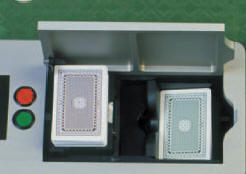
Can ShuffleMaster Automatic Card Shuffle Machines Cheat You?


I have recently received several e-mails asking me about Shuffle Master’s automatic card-shuffling machines, mainly whether or not they can be manufactured to cheat by Shuffle Master itself by way of performing false shuffles or fixed shuffles, and whether casino personnel can manipulate the card shuffling machines in order to cheat blackjack, poker and baccarat players. Some of these writers expressed complaints about suspicious deals they witnessed and attributed to the Shuffle Master card shufflers.

Well, let’s take a look at this question in two parts. First: Could Shuffle Master itself produce card shuffle machines that cheat for casinos against the players? The answer is, of course they could. But they would need cooperation from casino personnel using their machines on blackjack and poker tables, where a big conspiracy would have to take place. In blackjack, this could be done by dealers looking to isolate clumps of 10-value cards and Aces, which they would keep away from players by placing them within the clump of cards behind the cut card that never gets dealt. Keeping those cards away from card counters as well as normal players would give the casino a substantial added advantage where no one could legitimately beat the game in the long run. But would Shuffle Master actually engage itself in a conspiracy with casinos to cheat players? Of course not. About the only way a Shuffle Master shuffling machine would be involved in a “false” or uneven shuffle is by way of a defective machine that just doesn’t properly or effectively shuffle the cards, resulting in clumps that may either benefit the casino or card counters and legitimate players.

But what about casino personnel manipulating the machines in furtherance of a cheating operation, mainly dealers with or without supervisor participation? Yes, this can happen. But it would probably not involve a defective card shuffler. All the dealer would have to do is simply turn off the machine or disable it in some other way. If he were looking to use or hold back a clump of high or low cards for a new shoe that he noticed during the shoe he’d just dealt, he could indeed accomplish this by manipulating the shoe. And this could be done without turning the shoe off. Any person skilled with this type of machinery would be able to tamper with the machines so that they appear to be shuffling completely when they are not. But again, this would take lots of involvement by various employees to avoid the risk of being seen tampering with the machines. I mean, after all, as the entire casino floor today is monitored by surveillance cameras 24/7, any “work” done on the Shuffle Master card shuffle machines would be recorded by surveillance cameras, thus surveillance personnel would have to be in on any scam.

Bottom line: I don’t think there is any risk worth worrying about as far as being a victim to a Shuffle Master cheating card shuffle machine.

Sunday, November 16, 2008

PokerSoftware.com Makes Play To Stop Online Cheats!

PokerSoftware.com Publishes Guidelines for Determining Legitimate Poker Software.

PokerSoftware.com is quickly becoming the go-to destination for poker players looking for answers on which poker software programs are legitimate and which are rip-offs amid the wide variety of poker software available nowadays.

San Jose, Costa Rica (PRWEB) November 15, 2008 -- Poker software news site PokerSoftware.com has received an onslaught of questions regarding the legitimacy of many programs that its members have run across. The poker software industry is still young. Like the poker world, it began to explode when little-known Tennessee accountant Chris Moneymaker won the 2003 World Series of Poker Main Event, vaulting poker to its place as the true American pastime. Now, poker software exists that can keep track of a player's results as well as that of his opponents. Other pieces of software reveal real-time odds and can aid players when selecting a table. PokerSoftware.com has taken the time to review over 50 of the world's most popular programs in order to give users an in-depth look at the pros and cons of each.

Although online poker rooms differ in their acceptance of certain types of poker software, each legitimate program is backed by a team of customer support personnel and technical specialists. Poker enthusiasts never have to guess if a program reviewed on PokerSoftware.com is genuine. Many of the poker software reviews on the site even include a full video analysis of the program, narrated by its team of experts.

However, all is not rosy. The industry, like many others in business, is full of get rich quick schemes. PokerSoftware.com exposed one such poker cheating software explaining why the program could never work at the tables. Still, many players fall prey to these dubious claims every single day. PokerSoftware.com resident expert Chris Wallace recently authored a feature article on the site asking users to exercise caution when purchasing programs that are unfamiliar to them. It has been one of the most popular articles to appear thus far.

If players stumble across new software, they should ask themselves if the program in question is making promises that don't make sense. Why would a person raking in thousands of dollars from the tables every night because he is cheating want to share his secrets for just $50? Second, software enthusiasts should ensure that the site has a forum. If it doesn't, it's an ominous sign for its legitimacy. Potential customers can also use popular search engine Google in order to gauge what has been said about the program elsewhere. Finally, interested buyers should also exercise common sense. If the program makes claims that appear too good to be true, then chances are it is not legitimate.

If in doubt, users of PokerSoftware.com can always post in the poker software forum. The site's staff will check it out and perhaps even review it. If a piece of software is nothing more than a rip-off, PokerSoftware.com will say so.

Thursday, November 13, 2008

UltimateBet And Absolute Poker COO Leggett Admits To Cheating On Both Sites

Absolute Poker and UltimateBet Poker COO Paul Leggett sat down to speak with the CBC (Canadian Broadcast Company) to discuss his company's trying times over the past 10 months. In a candid interview), Leggett fully admits there was cheating on both sites.

"Poker playing has always been marred by cheating scandals," the host points out, explaining further that the cheating scandal uncovered at both Absolute Poker and UltimateBet caused enormous outrage.

Leggett arrived on board at Absolute Poker in late August of 2007, around the same time that the cheating scandal was said to have occurred. Initially he was brought on to help merge both Absolute and UltimateBet onto one platform and to improve customer service as well as marketing.

Joe Norton of Kahnawake Gaming purchased Absolute/UtlimateBet from the original owners. Leggett claims that none of those original owners are still involved with the company.

Leggett explains that the first priority after uncovering the cheating scandal was to ensure those adversely affected were taken care of by his company. The perpetrator, who was someone internal, provided information to this extent as to which customers may have been affected. Leggett says that in exchange for this information, that individual was given protection.

"This is kind of unusual," the host points out. "You're allowed to do that?"

"Well, we can decide if we are going to press charges or not but because we were a victim in this thing our concern was making sure we got the money back and there wasn't a breach from other areas. "

Charges could be filed against that individual by the Kahnawake Gaming Commission at a later date, Leggett said.

Roughly $800,000 was stolen and Absolute was able to recover 100 percent of this money since it remained in the cheater's accounts. Absolute Poker had to pay well over a million to customers, however.

"Everyone got paid out plus," Leggett said. "The brand damage is something we'll be fighting for years."