Thursday, July 10, 2008

Barry Greenstein Talks About Cheating In CardPlayer Interview!


In an interview with Cardplayer Magazine, noted poker pro Barry Greenstein talks about cheating.

Interview:

Despite successfully surviving into day two of the 2008 World Series of Poker main event, Barry Greenstein has been nursing a short stack since the day's official "shuffle up and deal" announcement. However, Greenstein's long career of tournament experience is bound to weigh heavily in his favor when evaluating his chances of navigating his way through short-stack play.

Card Player caught up with Greenstein during the dinner break of day 2A to discuss his strategy for avoiding elimination.

Alex Porter: Last time we talked your circumstances were quite different. It was during event No. 39, $1,500 no limit hold'em, and you were among the chip leaders. During our conversation you gave me a sort of Greenstein primer to large stack tournament approach. At this point of the main event, your situation is almost the complete opposite. How does Barry Greenstein play a short stack?

Barry Greenstein: Well, I've been staying out of the way. I've had 10 times the big blind basically the entire day, which is short-stacked. Everyone at my table currently has 100,000 or more. I'm actually at my high point for the day, 22,000, so I've luckily gotten up to 20 times the big blind. It's still not breathing room because if anyone raises in I'm still in a move-in-or-fold mode. I don't have to open for all my chips if I am the initial raiser.

I'm trying not to play pots where there's no fold equity. I just made a questionable fold in the big blind with ace-queen. There were two strong European players to my right. One raised and the other reraised. They both had a lot of chips, so I gave them credit and laid down ace-queen. Instead of playing that pot, I raised on the button when no one else came into the pot and I also raised one to the right of the button.

So mostly what I've done the whole day is pick up the blinds when I'm in late position. I've just survived. I haven't really had many good hands. I got lucky the one time where I was all in with an ace-seven against a king-jack. By staying out of people's way, I haven't been able to play hands like small pairs, mid-range suited connectors, and suited aces in early position. I consider those drawing hands. I'm hoping to get ace-kings, ace-queens, and big pairs, but I've only gotten a couple of those the whole day.

AP: I did notice that there were occasions when you still open for a standard raise despite your short stack where a lot of inexperienced players may have elected to shove it all it. What were your thought processes with that play?

BG: I'm not sure if you noticed, but it's been a function of how much I have in front of me. When I'm 10-times the big blind or less, that's usually the barometer I use. I have been putting in my whole stack, but the times I've only been making a normal raise are because I've had a little more than that. I've been fortunate to have pretty passive players to my left the whole day who have let me get away with picking up their blinds. That's allowed me to survive.

AP: I did notice a span of three consecutive hands where you raised a standard amount and received a call from a player in a blind who check-folded to a single bet of yours on the flop.

BG: I've just been lucky in those situations. A couple of times I was unlucky earlier, and that was how I got short. This last time I was lucky that I raised in and they called and blanked on the flop. Frankly I didn't have much of anything either, but betting will give you a shot to win the pot if nobody hits anything.

AP: Right now you're seated at a table in the edge of the Amazon Room's green section, making you right up against the rail. I've noticed that several of the pros sometimes consider the crowds they attract to be a distraction. Do you agree?

BG: The spectators don't bother me because frankly they're always nice to me. However, one of the problems as I've gotten older is the way I have to hold my cards to see them. I'm nearsighted, so I can see them up close. So people on the rail can often see my cards. Although I've never had any reason to suspect anyone of cheating or anything like that, if I have a flush draw and hit it someone behind me might raise their hands and cheer! Most of the people on the rail are actually rooting for me because spectators tend to root for the players they know.

AP: But so far no messy situations?

BG: No. It's not like there's ever been anyone on the rail who has been mean to me. They're always friendly. It's more that generally you want to be the only one seeing your cards. I have no reason to suspect that anything's ever happened against me.

There is one exception that could easily happen. There are other players at the table and I'm sure they often have their friends watching. If they have one of their friends behind me I don't anticipate that they're going to cheat, but maybe at the break they'll say, "Barry had such-and-such a hand." It might help them out where they would otherwise not know what I was doing.

AP: Like the ace-queen fold you mentioned earlier.

BG: Yeah, exactly. Someone might see that and then say, "Hey, you can push him around still. He's not going to commit his chips unless he really has the goods." With the stack I have, I'm generally not going to be a caller. I'm going to be the one with the lead either moving in or as the initial raiser.

Wednesday, July 09, 2008

3 Accused of Stealing $108 Million Tropicana Casino Player List With Michael Jordon´s Name!


Three former Tropicana employees -- including a high-ranking executive -- were indicted yesterday on charges they stole a list, valued at $108 million, of more than 20,000 of the casino's top players.

One of them, John Conklin, is now the vice president of relationship marketing at Borgata -- Atlantic City's trendy casino. He made his mark at the Tropicana by luring sports stars and celebrities, according to people who knew him there.

The case provides a window into the high-power world of casino marketing, where lists of top players can mean big money. Marketing executives, whose job it is to schmooze high rollers, are typically precluded from taking lists with them when they move onto other casino jobs. Often they don't need to -- they keep their own records and gamblers also know how to reach them.

In this case, authorities said the three downloaded the identities of more than 20,300 patrons -- including addresses, phone numbers and casino ratings -- onto three separate discs labeled "Bette Midler." The Tropicana put the value of the information at more than $108 million.

"We charge that these marketers stole one of the most valuable assets of the casino," Attorney General Anne Milgram said in a news release. "This type of corporate espionage and theft involving proprietary information is a very serious crime."

The others indicted were Justin Litterelle, who later went on to work for Bellagio, one of the premier casinos in Las Vegas; and James DiMarco, who was trying to find a new job after losing his at the Tropicana. Each of the three charged face up to 10 years in prison and $150,000 in fines if found guilty of the most serious charges.

Conklin's lawyer, John Donnelly, said it was "inappropriate to comment at this time." Calls to lawyers representing Litterelle and DiMarco were not returned. Borgata did not return a call.

At least one former casino executive said he was shocked by the allegations. Dennis Gomes, who hired Conklin while he was president of resort operations for Aztar, Tropicana's former parent company, said he "couldn't imagine John doing anything wrong, and I'm not going to believe it until I see more.

"John Conklin is one of the best slot player development executives in the entire industry," Gomes said. "He's the greatest salesman on earth.

Justice director Gregory Paw said the three employees were working together at the Tropicana three years ago when they began talking about finding other jobs. Conklin was Tropicana's marketing vice president. Litterelle served under Conklin as a marketing analyst.

Conklin allegedly told Litterelle to download a list of the casino's top players, saying it would be "future leverage" that would help them bring gamblers with them when they found jobs elsewhere, officials said.

Conklin, a 47-year-old from Galloway, then went on to work for Borgata. Litterelle, a 26-year-old up-and-comer in the casino marketing world, moved to Las Vegas and took a job as a national marketing manager at Bellagio. He was there a little more than a year before he resigned voluntarily in November 2007, according to Gordon Absher, a spokesman for the Bellagio's parent, MGM Mirage.

DiMarco, 59, of Ocean City, eventually lost his job after the Tropicana's new owner slashed hundreds of jobs.

Conklin also is charged with witness tampering for allegedly having his attorney get Litterelle to sign a false affidavit.

Gomes said he first met Conklin while he was the casino boss of the Trump Taj Mahal in the 1990s. Conklin was a telephone salesman at the time.

"If the average guy sold 300 phones a year, he sold 300 a month," Gomes said.

Later, Conklin sold luxury boxes at Philadelphia's CoreStates Center, now known as the Wachovia Center. When Gomes moved to the Tropicana, he hired Conklin to work in player development.

Conklin made his mark using his sport connections to bring in sport stars and celebrities. Gomes said members of the Philadelphia Eagles were among Conklin's contacts. So were boxers. He also brought in Michael Jordan, Gomes said.

Another Major Baccarat Scam Rocks Macau!

It seems that baccarat scams are contagious the last few years. Last year, of course, we saw the biggest known casino scam in history flourish across baccarat tables in casinos across the US and Canada, resulting in dozens of arrests and plea deals, including those of the current Mayor of Seattle, Washington´s son. This time the locale for the latest major baccarat scam bust is Macau, which undoubtedly leads the "world league" in baccarat scam. It happened last June and the details are now coming out.

Two dealers from a Cotai casino were arrested by the Judiciary Police (PJ) on Monday for allegedly being trained to remember cards sequences and then telling their accomplices before they were to place bets. The PJ’s gaming-related Crime Division received a report from the casino which suspected their dealers of cheating out money
from baccarat tables, police spokesman Chan Kin Hong said. Five men were arrested including a 22-year-old and a 23-year-old dealer with one of the three masterminds coming from China’s Shangxi province. Mr. Chan said one of the dealers admitted to police that he was “invited” to participate in the scam and taken to a unit where he was trained on how to remember the sequence of about 10 cards when shuffled. The dealer also said he would text the cards’ order to his accomplices whom he’d never met and then they would come to the gaming tables as a customer and place bets
according to the information given. Police believed the illegal organisation had been operating for a few months, adding the dealer told them he received a 20 percent
share each time and had accumulated about HK$600,000 of illegal earnings in total.
The police spokesperson said the scam involved at least HK$3 million and the casino
was still calculating the total loss. The three purported gamblers arrested were all from Shangxi province aged 34, 36 and 37, while the 37-year-old surnamed Ma was one of the masterminds, Mr Chan said. The other two masterminds were still on the run. Police said the two dealers had no financial problems and believed that they were attracted to participate in the scam because of “greed”. The five suspects will be sent to the Public Prosecutions Office and charged with organised crime and fraudulent gambling. The Dealers were arrested for casino card cons. Police are showing the “loots” seized including gaming chips and cash from the mainland suspects and cards from the dealers which they used to practice for the crime.

Tuesday, July 08, 2008

Ultimate Bet Poker Cheating Scandal Getting Bigger!

Months passed since UltimateBet acknowledged in March of 2008 that management became aware of cheating allegations in January of 2008. The initial, albeit late, statement indicated that at least one player account was deemed to have abnormally high winning statistics and an unfair advantage at the tables. UB was “determined to complete a full and thorough investigation,” but no one had any idea just how long that would take.

Players waited. And waited. And by the middle of May, patience had worn thin. Posters on forums like PocketFives and 2+2 began making noise and demanding a response from UltimateBet. It became a heated discussion, several members of the media kept the story in the public eye (though no major poker magazines, with the exception of Poker Player Newspaper, would touch it), and players wanted answers. Nat Arem, poker player and key rogue investigator in the Absolute Poker scandal months ago, took to PocketFives with the information he had. “I’ve spoken with the guy who is, basically, leading the investigation at UB. I guarantee that he is working on it … While I can’t tell you a lot of what he’s told me, I can tell you that UB is not ignoring it internally. In fact, the delay in resolution is not at UB itself. They’ve done a very thorough investigation and they’re committing some very significant resources to make sure that it never happens again at AP or UB.”

While Arem is a trusted member of the forum community, the secretive nature of the post did not sit well with players. Although Arem let it be known that new management and ownership of UB would prove trustworthy in the future, it was the many months of delays, lack of correspondence with the public, and lack of player reimbursement information that was unsettling.

Members of the poker community were also putting pressure on UB-sponsored players to take a stand. Annie Duke chose to respond on PocketFives in a long and seemingly heartfelt statement. It was her recent decision to renew a contract with UB and become even more involved with online tournament operations there that drew the most scrutiny, and she responded with openness.

After meeting with UB management in Costa Rica, Duke wrote, “I came away satisfied with both the intent of the management team to deal honestly with the allegations, as well as with the integrity of the management team itself. That is coming from someone who was as skeptical as could be … I know that the management team is eager to make its findings public with the month [May] … Until then, I will continue to promote the UB brand because it is a brand I believe in and love and am deeply emotionally invested in.” With two respected people—Arem and Duke— acknowledging the unresolved issue, players still found it odd that so much time had passed without any word from UB. Forum posters spread the word as loudly as computer keyboards can, and it seemed to work. With threats of more negative publicity, UB finally produced a statement to address the insider cheating scandal on May 29, just one day before the 2008 World Series was set to start.

In the next issue, look for details of the UltimateBet statement about the scandal. Though it was more of a comprehensive release than the statement that “closed” the Absolute Poker mess, it left some questions in the minds of some players. Even so, the management that released the statement clearly hoped to put players’ minds at ease and start the reimbursement process. To be continued…

France´s Online Gaming Commission Devises New Laws To Combat Online Poker Cheats

France has made a wise decision to allow controlled and regulated access to its market by online casino operators, and has come up with model standards to address concerns as the gambling sites slowly are permitted to reach French citizens.

The president of the French National Crime Commission, Alain Bauer, devised a list of important steps to observe as the market is gradually opened. The problems foreseen by opponents of online gambling are covered, with measures included to limit potential damage.

France will create a regulatory agency, responsible for monitoring and licensing applicants for legal online gambling. Servers will need to be accessible to this agency, so that software and records can be audited and monitored for fraud or cheating.

Only online casinos with a history of seven or more years will be allowed to apply.

Full disclosure and transparency will be required of all online gambling sites, including investors and shareholders as well as employees passing background checks.

Player registration would involve submission of a legal form of identification, including a French bank account, and issuing of a distinct PIN for activation and play.

Sharing of information, such as suspicious sports betting patterns, with the government is demanded, as well as regulation similar to that against insider trading to prevent wagering by sources with team or player connections.

A system to detect and block gamblers identified as problem gamblers must be in place.

The steps that France has carefully considered appear to do an excellent job of protecting their citizenry, far better than a ban leaving online gambling to uncontrolled entities. Maybe the United States could take a lesson.

Wednesday, July 02, 2008

Is 2008 World Series of Poker Gonna Be Cheat-Free?/Another Guilty Plea in International Baccarat Scam


I have not heard of any cheating allegations so far at this year`s WSOP, but don`t hold your breath too long thinking that the 2008 super poker tournament will finish up without any cheating scandals. If you do hold your breath, don`t forget that you will have to wait until mid-November to bear witness to a cheating-free WSOP--if it does indeed happen. For those of you who don`t realize it, there will be nearly a four-month interim between the determination of the final table of the 2008 WSOP championship event and the play of that final table, during which lots of time for conspiring, scheming and pre-cheating will be available for those directly and indirectly involved in the giant pot of prize money.

The WSOP in recent years has had its share of scandals. In 2005, counterfeit tournament chips were found in two different events. In 2006, the eventual champion Jamie Gold was accused of renegging on a prize-money percentage deal he`d made with a backer before the championship event began, and last year well-known and respected tournament player Bill Chen was accused of suspicious deal-making that supposedly led to chip-dumping and softplay incidents.

I will be very surprised if the 2008 WSOP championship event escapes scandals and scandalous activity, but we will have to wait and see. But with four months of "WSOP idleness," I can only imagine what schemes and scams are going to be concocted with all those millions at stake!

IN OTHER NEWS, another participant in the biggest casino scam in history pleaded guilty in court. You all remember the humongous international baccarat scam that hit dozens of casinos in the US and Canada last year and corrupted at least that many casino employees, most notably dealers and pit personnel. Well, now the major players in that scam are falling like dominoes with their guilty pleas in front of federal judges. The latest, Son Hong Johnson, 45, pleaded guilty today in San Diego to conspiring to participate in a racketeering enterprise, the "Tran Organization," in a scheme to cheat casinos across the country out of millions of dollars, Acting Assistant Attorney General for the Criminal Division Matthew Friedrich, U.S. Attorney for the Southern District of California Karen P. Hewitt and U.S. Attorney for the Western District of Washington Jeffrey C. Sullivan announced today. Johnson also pleaded guilty to conspiring to commit theft from the Emerald Queen Casino, an Indian tribal gaming establishment near Tacoma, Wash.

A three-count indictment was returned in San Diego on May 22, 2007, and unsealed on May 24, 2007, charging Johnson and 13 others each with one count of conspiracy to participate in the affairs of a racketeering enterprise; one count of conspiracy to commit several offenses against the U.S., including conspiracy to steal money and other property from Indian tribal casinos; and one count of conspiracy to commit money laundering. As part of his plea agreement, Johnson agreed to have a separate indictment against him transferred to San Diego for plea purposes. The separate indictment, returned on May 24, 2007, in the Western District of Washington, charged Johnson and seven others for alleged violations related to card-cheating activity at the Emerald Queen Casino.

The San Diego indictment also charged five separate individuals each with one count of conspiracy to commit several offenses against the U.S., including conspiracy to steal money and other property from Indian tribal casinos; and one count of conspiracy to commit money laundering.

In his plea agreement, Johnson admitted that on numerous occasions between approximately March 2003 and July 2006, he participated in gambling cheats together with other alleged members of the Tran Organization at casinos, such as: Emerald Queen Casino in Tacoma; Foxwoods Resort Casino in Ledyard, Conn.; Mohegan Sun Resort Casino in Uncasville, Conn.; Resorts East Chicago Hotel and Casino, East Chicago, Ind.; and Horseshoe Casino and Hotel, in Tunica, Miss.

Also in the plea agreement, Johnson admitted that he and his co-conspirators unlawfully obtained up to $7 million during card cheats. For forfeiture purposes, he agreed to a personal money judgment in the amount of $155,000, which will be entered by way of a preliminary order of forfeiture. He also acknowledged that the restitution that he may be ordered to pay by the court at sentencing is not limited by the forfeiture amount.

According to the indictment, the defendants and others executed a "false shuffle" cheating scheme at some of the listed casinos during blackjack and mini-baccarat games. The indictment alleges that members of the criminal organization bribed casino card dealers and supervisors to perform false shuffles during card games, thereby creating "slugs" of un-shuffled cards. According to the indictment, after tracking the order of cards dealt in a card game, a member of the organization would signal to the card dealer to perform a "false shuffle," and then members of the group would bet on the known order of cards when the slug appeared on the table. By doing so, members of the conspiracy repeatedly won thousands of dollars during card games – up to $868,000 on one occasion.

The indictment also alleges that the members of the organization used sophisticated mechanisms for tracking the order of cards during games, including hidden transmitter devices and specially created software that would predict the order in which cards would reappear during mini-baccarat and blackjack games.

An indictment is merely an allegation and is not evidence of guilt. A defendant is entitled to a fair trial in which it will be the government’s burden to prove guilt beyond a reasonable doubt.

Johnson’s sentencing is scheduled for Dec. 8, 2008, in San Diego, before District Judge John A. Houston, in U.S. District Court for the Southern District of California. At sentencing, Johnson faces a maximum sentence of 20 years in prison on the racketeering conspiracy charge and a maximum of five years in prison on the conspiracy charge relating to theft from an Indian tribal gaming establishment.

Johnson is the eleventh defendant to plead guilty in the San Diego indictment. Phuong Quoc Truong, Anh Phuong Tran, Martin Lee Aronson, Liem Thanh Lam, George Michael Lee, Barry Wellford, Willy Tran, Tuan Mong Le, Duc Cong Nguyen and Han Truong Nguyen have all pleaded guilty to charges against them related to this scheme. Han Truong Nguyen was sentenced on May 12, 2008, to 27 months in prison and ordered to pay $1,896,659 in restitution, payable to designated victims in the case. Nguyen was also ordered to serve three years of supervised release. The remaining defendants who pleaded guilty are awaiting sentencing.

The case is being investigated by the FBI’s San Diego Field Office; the Internal Revenue Service-Criminal Investigation; the San Diego Sheriff’s Department; and the California Department of Justice’s Bureau of Gambling Control. The investigation has received assistance from federal, state, tribal and foreign authorities, including: the Ontario Provincial Police; the National Indian Gaming Commission; the U.S. Attorney’s Office for the Western District of Washington; FBI Resident Agencies in Gulfport, Miss., Tacoma, and Toledo, Ohio; the Indiana State Police; the Rumsey Rancheria Tribal Gaming Agency; the Sycuan Gaming Commission; the Barona Gaming Commission; the Mississippi Gaming Commission; the Washington State Gambling Commission; and others. The prosecution of the case is led by the Criminal Division’s Organized Crime and Racketeering Section (OCRS). Department of Justice Trial Attorneys Joseph K. Wheatley, Robert S. Tully and Gavin A. Corn are prosecuting the indictment in San Diego. Assistant U.S. Attorney J. Tate London of the U.S. Attorney’s Office for the Western District of Washington, is prosecuting the case in Seattle related to alleged cheating at the Emerald Queen Casino.

Sunday, June 29, 2008

Annie Duke Speaks Out Again on Absolute Poker and Ultimate Bet Cheating Scandals


The cheating scandals surrounding online poker sites UltimateBet.com and its sister Absolute Poker.com continue to make waves in both the mainstream and industry media and in the player community, and the latest element in what seems to be a concerted damage control initiative by the owners is a Poker News video-streamed interview with the much respected poker pro Annie Duke.

This can be accessed at the Poker News Website,

Duke has a long association with UltimateBet and has been involved in both operational and branding endorsement for the website. Apparently last fall she was disenchanted with the way things were going and was thinking about distancing herself from the enterprise. In January this year, the 'hole card' scandal broke and apparently the change of management that occurred convinced Duke to revise her position in a move that was "a big 180 for me."

The cause of this epiphany was apparently the transparency of the new management, headed by CEO Paul Leggett; the way in which it handled the crisis (paying out an unspecified but claimed "seven figures" to affected players); getting rid of the "bad apples" responsible for the scandal and a bigger say for Duke in the conduct of the business.

Judging by her comments in the interview Duke is now firmly on board and confident that the historical problems have been fully addressed, although management is still considering the pursuit of those responsible. This is apparently problematical due to legal considerations around identifying the culprits and under which jurisdiction to pursue them.

Duke follows the company line in claiming that company revenues were not affected by the crisis, which is surprising when one considers the magnitude of the cheating and the editorial coverage it received. The company strategy of recruiting big poker names to endorse the website is also apparent in her comments.

Listening to the interview, there are confusing references to both 'change of management' and 'change of ownership'. This gives little clarity on who owned Absolute/Ultimate Bet prior to its acquisition by Tokwiro Enterprises, a Kahnawake registered company owned by former Mohawk grand chief Joe Norton, or what Tokwiro paid for the companies and when.

The UltimateBet story is not about to fade away. In her interview Duke confirmed information circulating for some months in the industry that the mainstream television investigative program "60 Minutes" is about to air the scandals. Producers for the program contacted Duke whilst she was at the ongoing World Series of Poker, although she does not amplify what was discussed.

Subjectively speaking, we had the impression that this was a continuation of the damage control initiative which the "new management" has been so vigorously pursuing, suggesting that the impact of the cheating scandal may have been bigger than UB would like to acknowledge. The role of the major poker forums in driving the resolution of these scandals also appeared to be underplayed, whilst the proposition that bashing UB was not good for the industry is arguable.

That said, the potential for harm to the industry's credibility that an adverse "60 Minutes" take on the affair is likely to have is a legitimate concern. What a pity that the systems at UB/AP failed in the first place, bringing about this crisis.

July Scam of the Month Posted!

My July scam of the month is "The Cooler." I am not talking about the 2003 casino movie of the same name starring Alec Baldwin and William H. Macy, but rather of a very effective casino cheating scam used by dealers to rip off the casinos they work in. Click here to read about it.

Thursday, June 26, 2008

New Roulette Tables To Fight Cheats


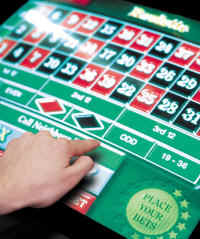
Roulette tables may get touch screens to combat cheating!

If Microsoft's "Surface" becomes a casino fixture next to the slot machines, the touch-screen table computer will find plenty of company. Not only are digital poker tables being developed--complete with "peel up" card corners so players can read their hands discreetly--but even touch-sensitive roulette games are on the way.

There have been attempts in the past to develop "pastpost free" roulette tables, but those failed mainly because the added protection brought along with it too many inconveniences, such as alarms going off when players innocently reached over the layout to lend a cigarette lighter or shake a hand while the table´s anti-pastposting device was activated to catch roulette players´ hands on the layout when they weren´t supposed to be there, mainly after the dealer had already marked the winning number with the dolly, at which time any hands entering the layout were detected as possible cheat tools. Similar to radio frequency identification (RFID) technology, this latest "safe casino play" invention should be more successful than its forebearers, but as RFID technology has been very slow to catch on worldwide in casinos, we will have to wait and see just how much a pain in the...hand...these touch screen roulette tables will be.

The "MultiPlay Roulette" system is the latest from Sweden's TouchTable, featuring a 56-inch touch LCD with 3,840 × 2,160 resolution. The table can accommodate up to seven players and, thanks to the company's proprietary technology, it can identify each person's bet.

Like other digital casino products, the idea is to speed the pace of play and reduce the chances of discrepancies or cheating. Because, as some of us have learned painfully over the years, fast play always favors the house.

To read a magazine article I wrote on RFID technology in casinos, click here.

Tuesday, June 24, 2008

Bodog Signs Another Poker Cheat!


Bodog Signs Reformed Justin Bonomo!

It seems to be par for the course: Get caught in an online poker scam, then say you´re sorry, apologize to everyone and his mother reading the poker blogs, then sign a deal for big bucks with a major online poker room. Such is the case again, this time with Justin Bonomo, better known as "ZeeJustin" who was caught cheating by playing on multiple accounts on sites like PartyPoker and PokerStars. (To read more on previous online cheats who signed big poker deals, click here.

Oh how I wish I had been caught cheating at online poker! Then I could have signed a big contract with Bodog too! Only problem, I was never an online poker cheat. In my next life, I will have to consider changing professions!

As reported by Jennifer Newell:

On May 5th, 2008, Bodog Poker announced that it had signed Justin Bonomo to its roster of pros, which already includes David Williams, Jean-Robert Bellande, and Evelyn Ng. Justin will represent Bodog both in live tournaments and online at Bodog, as well as possibly participating in other marketing and branding opportunities.

Poker pros ink deals regularly with online poker sites. Why is this one significant and worthy of a column? Because Justin is the Justin Bonomo, better known as “ZeeJustin” in online poker circles—the player who was caught cheating by playing on multiple accounts on sites like PartyPoker and PokerStars. And though he didn't handle the scandal well when it happened—he was not even 21 years old—he has since matured, taken particular care to address the problem, and changed.

When the scandal first broke in early 2006, Justin was not afraid to post on web forums with his excuses and justifications for using multiple accounts. He claimed that he did so because his style under “ZeeJustin” was too wellknown, and he needed to be anonymous in order to win more money. Granted, that is a simplification of his reasons for the sake of space in this column.

Eventually, the wrath he felt from the poker community caused Justin to realize the impact of what he had done, and his justifications turned to apologies. In his immaturity, he even attempted to strike a deal with PokerStars that would allow him to play on the site for several months, with all proceeds going to charity. “For me, the benefits are obvious,” he wrote to PokerStars. “I would get to play on your site again and return some credibility to my name, but more importantly, I see this as a way to become the person I've always told myself I would be. This won't be a one-time thing. This is how I want to live the rest of my life… Basically, I realize that what I've done is terrible, but I

refuse to accept the fact that those actions define me as a person. I see this as a way to overcome what I've done, not as a poker player, or a wanna-be celebrity, but as a human being.”

The site ultimately denied his request. Justin then took his poker skills to the live tables once he became of legal age to play in the United States. He played tournaments humbly and quietly, not drawing any attention to himself. He allowed time to heal wounds, and in the year and a half that he has been on the circuit, he has eventually gained the respect of many poker players who have seen his remorse and witnessed his true love of the game.

What makes Justin different from recent players involved in cheating scandals, like Sorel Mizzi and JJ Prodigy, is that he grew to understand the severity of his previous actions and let some time pass as he carefully repaired his image. Though he's still in his very early twenties, he seems to have matured immensely. Players like Mizzi seem to expect immediate acceptance of whatever apology is issued, and they come to tournaments as cocky and full of themselves as ever. As basic as it may seem, people need time to accept apologies and see another side of those players, and Mizzi is one of several who do not seem to understand this.

Justin Bonomo has become a successful live tournament player, with final tables at EPT and WSOP events to his credit, as well as several near-televised WPT tables. He has made over $1.1 million in his short time on the circuit, and the Bodog sponsorship appears to be a positive step in his journey.