
Here we go again! I said it two and half years ago, that hole cards were being exposed in online poker games, and nearly everyone in the poker community called me crazy. But now Tokwiro Enterprises, owner of both Absolute Poker and UltimateBet, has had to come out of the closet and admit that its second prized online poker site
was devastatingly compromised, after its first, Absolute Poker, suffered the same blow from the same peeking-at-hole-cards scam.
The headlines blared: Close Former Employees Had Access to Opponents' Holecards for 21 Months
Tokwiro Enterprises, the company that owns both Absolute Poker and UltimateBet, today released a statement confirming that cheating had gone on at UltimateBet by people who, according to the release, “worked for the previous ownership of UltimateBet prior to the sale of the business to Tokwiro in October 2006.”
The player or players behind the 18 screen names that were identified as being corrupted have not been named. Tokwiro will refund players their losses once the investigation is complete. The usernames that were used to cheat are: NioNio, Sleepless, NoPaddles, nvtease, flatbroke33, ilike2win, UtakeIt2, FlipFlop2, erick456, WhackMe44, RockStarLA, stoned2nite, monizzle, FireNTexas, HeadKase01, LetsPatttty, NYMobser, and WhoWhereWhen.
The cheating was able to take place because the perpetrators had access to what Tokwiro is calling an “unauthorized software code” that allowed the cheaters to see their opponents’ holecards. The cheating took place from March 7, 2006 to Dec. 3, 2007, and it’s not known how much money the cheater(s) illicitly won.
As soon as the cheating was suspected, Tokwiro said it contacted the Kahnawake Gaming Commission (KGC), the most used online poker regulatory commission, to start the investigation. Tokwiro is mandated to contact KGC if any suspicious activety might be taking place.
This is the second cheating incident to hit the company since it purchased Absolute
Poker and UltimateBet. The first occurred when it was discovered that several players at Absolute Poker also had access to software that allowed them to see opponents’ hole cards.
The entire press release, which provided a timeline of the incident, follows:
MONTREAL, CANADA (MAY 29, 2008) --- Tokwiro Enterprises ENRG ("Tokwiro"), proprietors of UltimateBet.com ("UltimateBet"), one of the world's largest online card rooms, today announced the results of its lengthy investigation into allegations of unfair play, which was triggered by concerns about an account named 'NioNio'. Tokwiro has worked diligently in cooperation with its regulatory body, the Kahnawake Gaming Commission ("KGC"), and with independent third-party experts to conduct a thorough investigation that included a comprehensive review of hand histories and game data, thorough analyses of software and network security, and audits of its security practices and procedures.
The investigation has concluded that certain player accounts did in fact have an unfair advantage, and that these accounts targeted the highest limit games on the site. The individuals responsible were found to have worked for the previous ownership of UltimateBet prior to the sale of the business to Tokwiro in October 2006. Tokwiro is taking full responsibility for this situation and will immediately begin refunding UltimateBet customers for any losses that were incurred as a result of unfair play.
The fraudulent activity was enabled by unauthorized software code that allowed the
perpetrators to obtain hole card information during live play. The existence of this
vulnerability was unknown to Tokwiro until February 2008 and existed prior to
UltimateBet's acquisition by Tokwiro in October 2006. Our investigation has confirmed that the code was part of a legacy auditing system that was manipulated by the perpetrators. Gaming Associates, independent auditors hired by the KGC, have confirmed that the software code that provided the unfair advantage has been permanently removed.
Throughout the investigation of this incident, Tokwiro's consistent priorities have been:
To permanently remove the ability to engage in unfair play.
To complete its investigation and come to a full understanding of what occurred.
To refund the affected customers.
To implement measures that prevents future incidents.
The Company said, "We would like to thank our customers for their patience, loyalty and support, as well as for their understanding that we are doing everything we can to correct this situation. The staff and management of UltimateBet are fully committed to providing a safe and secure environment for our players, and we want to assure customers of our unwavering resolve to monitor site security with every resource at our disposal."
Investigation Timeline
These are the key events in the course of the incident.
January 2008: UltimateBet is alerted to suspicions of unfair play on the part of the
account "NioNio". Within 24 hours, UltimateBet contacts the KGC to provide formal notice that UltimateBet has initiated an investigation of the incident.
UltimateBet subsequently forwarded a copy of all related data to the KGC.
January 2008: The "NioNio" account and related accounts are suspended pending further investigation.
February 2008: Preliminary findings indicate abnormally high winning statistics for the suspect accounts. After discussions with the KGC, UltimateBet engages third-party gaming experts to assist with the analysis.
February 2008: Investigators confirm that the suspect accounts are associated with
individuals who had worked for UltimateBet under the previous ownership.
February 2008: UltimateBet discovers the unauthorized code that allowed the perpetrators to obtain hole card information during live play. The code was part of a legacy auditing system that was manipulated by the perpetrators of the fraud.
February 2008: UltimateBet immediately removes the unauthorized code and works with the KGC and with third-party auditors to verify that the security hole has been eliminated.
March 2008: Six player accounts are confirmed to have participated in this scheme. No accounts were deleted at any point, although some account names were changed multiple times. The following account names are known to have been used in the fraudulent activity: NioNio, Sleepless, NoPaddles, nvtease, flatbroke33, ilike2win, UtakeIt2, FlipFlop2, erick456, WhackMe44, RockStarLA, stoned2nite, monizzle, FireNTexas, HeadKase01, LetsPatttty, NYMobser, and WhoWhereWhen.
May 2008: The investigation confirms that the fraudulent activity took place from March 7, 2006 to December 3, 2007.
May 2008: Gaming Associates certifies that the software code that enabled unfair play was removed from UltimateBet servers in February of 2008.
May 2008: Customers affected by this incident are identified, and plans for corrective action are reviewed with the KGC.
Corrective Actions Taken:
The following actions have been taken or are currently underway as a direct result of this investigation:
The security hole identified in UltimateBet's investigation has been permanently
eliminated.
UltimateBet is establishing a state-of-the-art software Security Center that
consolidates and greatly enhances existing security capabilities. The first release of the new Security Center focuses solely on the immediate detection of abnormal winnings. Gaming mathematicians, poker professionals, and security software developers have all contributed to the specifications for the new Security Center.
UltimateBet customers are no longer permitted to change account names unless they have suffered abuse in chat rooms. Requests for changes must be supported by proof of abuse and must be approved by the Chief Compliance Officer. In addition to its existing security department, UltimateBet has established a new specialized Poker Security team of professionals dedicated to fraud prevention.
The refund process will begin immediately. The accounts associated with fraudulent
activity did not use an unfair advantage in all play sessions. Regardless, UltimateBet is refunding all losses to these accounts.
Accounts related to the fraudulent activity have been disabled, and the individuals
associated with those accounts permanently banned from the site. UltimateBet has worked closely and transparently with its governing body, the KGC and its designated expert auditors, to determine exactly what happened, how it happened, and who was involved, and has taken action to prevent any possibility of this situation
recurring.
Tokwiro is pursuing its legal options in regard to this incident.
WHEN WILL IT END???
Saturday, May 31, 2008
June Scam Of The Month Is Posted!
The scam of the month for June is Card Swapping at brick and mortar poker tables. This is a devious scam pulled off by two cheating partners at the poker table who leave no cards unswapped! To read it, go to my Scam of the Month page.

Thursday, May 29, 2008
Bwin Declares War On Cheats Using Poker Bots!
ICU INTELLIGENCE TO IMPLEMENT BotGuard, a pokerbot detection system, at bwin!
The war against poker bots is escalating! In a deal with ICU Intelligence, a data mining and predictive database analysis company, the huge online casino, poker and sports betting company known as bwin has taken the war against poker bots to the very Internet they breed on. With the development of BotGuard, ICU Intelligence has armed bwin with the first real orchestrated online defense against bots. If you are not familiar with the ongoing online war between poker sites and poker cheats using bots, the text below lays out the battlefield.
At a time when the number of internet poker players continues to rise, the number of people trying to take advantage of the game also increases. Auxiliary cheating software that recommends poker actions is becoming an increasing problem. In some cases the software plays without human interaction, a so called poker bot, which gives the player using such software an advantage towards ordinary players. bwin has always been in the forefront of this battle and takes every precaution to stop the fraudsters who are using poker bots. However, as the technology of the poker bots develops and becomes more sophisticated, new methods are needed to combat the problem. ICU’s BotGuard is designed specifically to find and detect the player patterns that single out poker bots from the human players.
“The increasing complexity and the amount of data that needs to be processed in order to detect poker bots is tremendous” says Kevin O’Neal, Press Officer at bwin. “BotGuard has the ability to detect complex patterns with tiny shades of differences in huge databases, which allows it to find the players that are using illegal software. This is what made us choose ICU’s solution as our next step in the fight against poker bots.”
ICU’s unique cutting edge technology, based on Artificial Intelligence, is what powers BotGuard. This gives it the ability to analyse and process the huge amounts of data required to search for bots among the masses of ordinary players. The fingerprint on every player is unique and every bot has its unique playing patterns. The way a person plays over time changes. A bot on the other hand plays in a similar way with few small variations. ICU’s BotGuard finds and flags suspicious players, allowing bwin’s fraud specialists to undertake a more thorough investigation before the appropriate countermeasure is executed.
“ICU is very pleased and excited to work closely with bwin.” says Andreas Holmström, CEO ICU intelligence. “bwin is a pioneer in the online poker development and we are proud that they are choosing ICU as their partner when it comes to surveillance against cheaters on their poker network.”
The war against poker bots is escalating! In a deal with ICU Intelligence, a data mining and predictive database analysis company, the huge online casino, poker and sports betting company known as bwin has taken the war against poker bots to the very Internet they breed on. With the development of BotGuard, ICU Intelligence has armed bwin with the first real orchestrated online defense against bots. If you are not familiar with the ongoing online war between poker sites and poker cheats using bots, the text below lays out the battlefield.
At a time when the number of internet poker players continues to rise, the number of people trying to take advantage of the game also increases. Auxiliary cheating software that recommends poker actions is becoming an increasing problem. In some cases the software plays without human interaction, a so called poker bot, which gives the player using such software an advantage towards ordinary players. bwin has always been in the forefront of this battle and takes every precaution to stop the fraudsters who are using poker bots. However, as the technology of the poker bots develops and becomes more sophisticated, new methods are needed to combat the problem. ICU’s BotGuard is designed specifically to find and detect the player patterns that single out poker bots from the human players.
“The increasing complexity and the amount of data that needs to be processed in order to detect poker bots is tremendous” says Kevin O’Neal, Press Officer at bwin. “BotGuard has the ability to detect complex patterns with tiny shades of differences in huge databases, which allows it to find the players that are using illegal software. This is what made us choose ICU’s solution as our next step in the fight against poker bots.”
ICU’s unique cutting edge technology, based on Artificial Intelligence, is what powers BotGuard. This gives it the ability to analyse and process the huge amounts of data required to search for bots among the masses of ordinary players. The fingerprint on every player is unique and every bot has its unique playing patterns. The way a person plays over time changes. A bot on the other hand plays in a similar way with few small variations. ICU’s BotGuard finds and flags suspicious players, allowing bwin’s fraud specialists to undertake a more thorough investigation before the appropriate countermeasure is executed.
“ICU is very pleased and excited to work closely with bwin.” says Andreas Holmström, CEO ICU intelligence. “bwin is a pioneer in the online poker development and we are proud that they are choosing ICU as their partner when it comes to surveillance against cheaters on their poker network.”
Tuesday, May 27, 2008
Rash of Sportsbooks Cheats and Scams! How to Avoid Them!

I have been getting tons of e-mails asking me about the safety of doing business with various online sportsbooks. Although sportsbook scams and cheat operations do not get the online press that poker scams do, believe me, they are prevalent out there in the cyberworld. Not only are there the typical scenarios where online sportsbooks go belly-up and out of business, leaving account-holders holding nothing but air, several sportsbooks operations are set up just to do that: abscond with account-holders´ funds once the accounts are opened, without a first bet even being made.
In additon to these online sportsbook scams, there have been shady individuals involved with online sportsbooks, especially those based in Costa Rica, who have been accused of more widespread criminal activities on several continents.
According to a report filed over a year ago by the U.S. Department of Justice (DOJ), Jaime Ligator, owner of the Horseshoe casino in San José, detained last May 18, contributed financially to the opening a call centre that was presumable used to defraud dozens of Americans with false prizes.
Ligator, when he was arrested, was the president of World Wide Land Investments which had offices on the third floor of Mall San Pedro. This is a firm that specializes in selling lots to North Americans, according to AM Costa Rica.
A former sportsbook owner, Max Allan Stone, was also named in the case and alleged to have been part of the scam that preyed on mostly elderly citizens living in the United States.
The scam artists called people in the United States informing them they had won a lottery. The victim was then supposed to send a “deposit” anywhere from $300 to $4,000 via Western Union, a police spokesman told AM Costa Rica.
Another of those named in the complaint, Severin Marcel Stone, 28, and presumably a relative of Max Allan, is being extradited back to the United States.
Severin Marcel Stone was detained in January in San Rafael de Escazú where he operated a food outlet in a shopping mall.
THE BetOnSports BUSTOUT
The BetOnSports saga continued last week with notification that they "do not anticipate that any distribution to creditors will be any more than a few cents on the dollar". Those players who were left with substantial account balances at the time of BOS's demise are starting to look like they will come away completely empty-handed. Unfortunately this is not the first offshore sportsbook failure, nor will it be the last.
HOW TO AVOID BECOMING A DEFUNCT SPORTSBOOK VICTIM
I would give you these suggestions to avoid losing your funds on account with sportsbooks that either go belly-up or are just plain scam operations:
Avoid credit wagering. While gambling on credit certainly has its place, and its benefits, it often leads into very murky waters. If offered a credit account from someone unknown to you, run, don't walk. This includes "forum personas" - plenty of scam artists have utilized credit offers through internet forums to rip-off unwary players. With no guarantee that you will be paid, you are setting yourself up for disaster. Be especially cautious of operations employing stateside credit agents - even if their intentions are honorable, the high risk of prosecution make this route generally unappealing.
Do business only with the cream of the crop. Appearances can be deceiving, and a well-designed website can easily disguise the fact that some sportsbooks are literally operated out of shacks in 3rd world countries. The biggest factor in sportsbook failure is lack of adequate cash flow, and most start-up operations are vastly undercapitalized. Large sportsbooks in operation for 5 or more years likely have had time to amass a cash reserve, and have a good enough handle on operating costs to keep themselves afloat. The same can't be said for smaller or newer sportsbooks, who represent a much riskier place to park your bankroll.
Stick to books advertising on well-known internet websites and gambling portals. While plenty of pump-and-dump schemes have been propagated through online gambling forums, most website owners will at least go to bat for those who signed up through their referral links if one of their advertisers goes belly-up. This, of course, varies by website owner. Most provide at least some degree of screening of their advertisers, and many have plenty of "inside connections" that can sometimes be used to expedite payments or resolve disputes. While this provides no guarantees of assistance, it at least leaves extra options open in extricating yourself from a sticky situation.
"There's no such thing as a free lunch." Be wary of incentives that seem too good to be true. Sportsbooks on the decline will often attempt to increase operating capital by enticing customers with generous deposit bonuses. In many cases, this is simply a case of robbing Peter to pay Paul as your post-up money goes right back out the door to process backlogged withdrawal requests. Don't get suckered into the tail end of a failing Ponzi scheme. Well-run (and well-capitalized) sportsbooks have no need for eye-popping incentives, which are often signs of desperation.
Diversify. The BetonSports saga has illustrated that no book is absolutely safe, regardless of backing, reputation, or business savvy. No one knows for sure if a book may fold, go bankrupt, or just pick up and walk away with customers' deposits. Spreading yourself out between 5 to 10 independently-run sportsbooks is a nice insurance policy if something unforeseen should happen to one of your standard "outs". Even a complete failure of one of your sportsbooks will only chop off a limited 10-20% of your total bankroll - not an attractive ending, but better than having all your eggs in one basket.
Keep balances low, and make frequent "profit-taking" withdrawals. Keep the minimal amount necessary for your daily betting in each account. The cash you keep offshore should be funds you are willing to lose in a worst-case scenario. Run up the score on one of your books? Take that opportunity to request a payout and preserve your capital - cash in a shoebox under your bed can't fall victim to offshore shenanigans. The goal should be to keep as little of your cash at risk as possible while staying funded well enough to avoid missing any profitable opportunities.
Sunday, May 25, 2008
Casino Money Laundering Rampant in Canadian Casinos!
According to the Peace Arch News, criminals and cheats are using Canada´s casinos to wash their ill-gotten gains. Money laundering is nothing new to casinos, especially in Las Vegas and Macau, but this is the first time I´m hearing of major money-laundering operations going on in Canada.
VICTORIA – The provincial and federal governments are checking into reports that B.C. casinos are being used to launder large amounts of money by people posing as high-rolling gamblers.
CBC News reported last week that its reporters were able to go into casinos, feed thousands of dollars in cash into slot machines, then exchange the credits for a casino cheque after little or no actual gambling.
Provincial and federal laws require that suspicious transactions be reported to provincial gaming enforcement officials and the federal agency responsible for policing financial transactions. Documents released under freedom of information legislation showed that suspicious incidents were reported by casino staff, but many of those did not end up being reported to Ottawa as the law requires.
In question period at the B.C. legislature Thursday, NDP critics grilled Public Safety Minister John van Dongen on the issue. Delta North MLA Guy Gentner asked why Ontario casinos reported suspicious transactions totalling more than $15 million in 2006, while B.C. reports the same year totalled only $60,000.
In the legislature and speaking to reporters outside, van Dongen would only say he has asked for a meeting with the B.C. Lottery Corp. board, and spoken to federal Public Safety Minister Stockwell Day about verifying the lottery corporation’s responsibilities under federal law.
He promised to take appropriate action and report to the legislature on his findings.
“The fact of the matter is there are very extensive reporting requirements on casino facilities,” van Dongen said.
“These reports go to the (B.C.) Gaming Policy Enforcement Branch, they review the reports, they work with enforcement agencies.”
Branch records show that in B.C. there were 48 money laundering investigations in 2004-05, 43 in 2005-06 and 51 in 2006-07. Only one case led to a criminal charge during that time.
The Gaming Policy Enforcement Branch deals with many more reports of crime related to casinos, including more than 1,000 cases a year of suspected counterfeit.
In 2006-07 the branch dealt with 570 complaints of theft, 193 of fraud, 118 of loan sharking, 344 of assault or threats and 43 complaints of cheating at gambling games.
NDP attorney-general critic Leonard Krog said the money laundering problem is similar to last year’s report by B.C. Ombudsman Kim Carter about inadequate controls on potential lottery ticket fraud by retailers.
VICTORIA – The provincial and federal governments are checking into reports that B.C. casinos are being used to launder large amounts of money by people posing as high-rolling gamblers.
CBC News reported last week that its reporters were able to go into casinos, feed thousands of dollars in cash into slot machines, then exchange the credits for a casino cheque after little or no actual gambling.
Provincial and federal laws require that suspicious transactions be reported to provincial gaming enforcement officials and the federal agency responsible for policing financial transactions. Documents released under freedom of information legislation showed that suspicious incidents were reported by casino staff, but many of those did not end up being reported to Ottawa as the law requires.
In question period at the B.C. legislature Thursday, NDP critics grilled Public Safety Minister John van Dongen on the issue. Delta North MLA Guy Gentner asked why Ontario casinos reported suspicious transactions totalling more than $15 million in 2006, while B.C. reports the same year totalled only $60,000.
In the legislature and speaking to reporters outside, van Dongen would only say he has asked for a meeting with the B.C. Lottery Corp. board, and spoken to federal Public Safety Minister Stockwell Day about verifying the lottery corporation’s responsibilities under federal law.
He promised to take appropriate action and report to the legislature on his findings.
“The fact of the matter is there are very extensive reporting requirements on casino facilities,” van Dongen said.
“These reports go to the (B.C.) Gaming Policy Enforcement Branch, they review the reports, they work with enforcement agencies.”
Branch records show that in B.C. there were 48 money laundering investigations in 2004-05, 43 in 2005-06 and 51 in 2006-07. Only one case led to a criminal charge during that time.
The Gaming Policy Enforcement Branch deals with many more reports of crime related to casinos, including more than 1,000 cases a year of suspected counterfeit.
In 2006-07 the branch dealt with 570 complaints of theft, 193 of fraud, 118 of loan sharking, 344 of assault or threats and 43 complaints of cheating at gambling games.
NDP attorney-general critic Leonard Krog said the money laundering problem is similar to last year’s report by B.C. Ombudsman Kim Carter about inadequate controls on potential lottery ticket fraud by retailers.
Mansion Poker Makes Move To Combat Cheating
Mansion Signs With Ethoca
Leading fraud management firm Ethoca Limited has announced that online casino Mansion.com has joined its global community of companies intent on reducing scams and increasing revenues. This seems like a good move to me in light of the continuing the seemingly nonstop barrage of online poker scams.
'The online gaming industry is strongly on board with the idea of collaborating to stop fraud with four of the top five and many more of the top 50 already committed to working together through Ethoca's community,” said Andre Edelbrock, President and Chief Executive Officer for Ethoca.
“As the rapidly emerging de facto standard for collaboration in this industry, we are very pleased to add Mansion.com as the newest member. Most fraud management is about reducing risk but Ethoca is unique because we're also about increasing revenues.'
Dublin-based Ethoca stated that its partner firms now include financial providers, Internet-based retailers and online gaming operators and that it increases profitability by distinguishing between reliable and unreliable transactions, which reduces losses and non-payment. It said that recent research discovered that better fraud management could result in e-businesses recovering more than $30 billion in previously foregone annual revenues.
"Offering the best value in online gaming means we must continue to stay at the cutting edge of fraud prevention to offer the best possible protection for our members,” said Guy Gussarsky, Chief Executive Officer for Gibraltar-based Mansion.com.
“Ensuring our players have an enjoyable, safe and worry-free gaming experience is our priority. Ethoca's innovative platform for anti-fraud collaboration is unique and allows Mansion.com to benefit from the payment experiences of other companies. It is a real breakthrough in fraud management."
Leading fraud management firm Ethoca Limited has announced that online casino Mansion.com has joined its global community of companies intent on reducing scams and increasing revenues. This seems like a good move to me in light of the continuing the seemingly nonstop barrage of online poker scams.
'The online gaming industry is strongly on board with the idea of collaborating to stop fraud with four of the top five and many more of the top 50 already committed to working together through Ethoca's community,” said Andre Edelbrock, President and Chief Executive Officer for Ethoca.
“As the rapidly emerging de facto standard for collaboration in this industry, we are very pleased to add Mansion.com as the newest member. Most fraud management is about reducing risk but Ethoca is unique because we're also about increasing revenues.'
Dublin-based Ethoca stated that its partner firms now include financial providers, Internet-based retailers and online gaming operators and that it increases profitability by distinguishing between reliable and unreliable transactions, which reduces losses and non-payment. It said that recent research discovered that better fraud management could result in e-businesses recovering more than $30 billion in previously foregone annual revenues.
"Offering the best value in online gaming means we must continue to stay at the cutting edge of fraud prevention to offer the best possible protection for our members,” said Guy Gussarsky, Chief Executive Officer for Gibraltar-based Mansion.com.
“Ensuring our players have an enjoyable, safe and worry-free gaming experience is our priority. Ethoca's innovative platform for anti-fraud collaboration is unique and allows Mansion.com to benefit from the payment experiences of other companies. It is a real breakthrough in fraud management."
Saturday, May 24, 2008
Ultimate Bet "NioNio" Online Poker Scam Widens!
ULTIMATE BET ONLINE POKER SCANDAL WON´T GO AWAY!
Worrying echoes of the Absolute Poker affair as cheating crisis remains unresolved.
Almost halfway through the year, the cheating accusations involving online poker site UltimateBet.com (see previous Online-Casinos.com/InfoPowa reports) have still to be brought to a satisfactory conclusion, and this week simmering player anger was again evident on leading Internet message boards such as 2+2 and Casinomeister.
The incident has worrying similarities with a major cheating scandal at sister online poker room Absolute Poker last year, which culminated in the venue receiving a half million dollar fine from the Kahnawake Gaming Commission, but little public indication that the perpetrators of the scam had been criminally pursued.
Absolute, which had initially shrugged off allegations of cheating by an insider, eventually paid players disadvantaged by the scandal, which was uncovered largely by astute detective work by the poker playing community.
UltimateBet and Absolute Poker are both fully owned by Tokwiro Enterprises ENRG, a privately owned company run by Joe Norton, the former Grand Chief of the Mohawk Territory of Kahnawake. Both sites are licensed by the Kahnawake Gaming Commission in a First Nation enclave near Montreal in Canada.
Disclosures over the past few months indicate that the players at 2+2 have again been instrumental in uncovering the alleged UltimateBet cheating involving a player using the handle "NioNio". In a summary posted this week at: http://forumserver.twoplustwo.com/showthread.php?t=208114 the thorough steps leading to the expose are detailed by Steven Ware and Cornell Fiji, but briefly the history is as follows:
Some 5 months ago allegations concerning suspicious activity in the high stakes no limit games on UltimateBet were first made public at 2+2 in a thread on the High Stakes No Limit forum. UltimateBet and the KGC were informed of the suspected cheating amid allegations that millions of dollars had been obtained through questionable high stakes play, and that it was likely that:
UltimateBet had known about the cheating for at least nine months.
UltimateBet knew about but did not make any attempt to acknowledge the cheating before it was exposed by the 2+2 poker portal.
Insiders working for UltimateBet had facilitated the cheating.
UltimateBet actively took steps to cover up these crimes and thwart any investigation.
UltimateBet did not make any public statements or acknowledge that cheating had occurred until March 6th, 2008, three full months after the allegations became public knowledge. Then, a release advised that after "extensive inquiry involving an independent third-party expert, NioNio account's winning statistics were indeed abnormal" but did not reveal whether an unfair advantage existed or what it may have been. It is claimed that this press release is the only occasion on which UltimateBet has publicly addressed the issue.
UltimateBet has not reached out to any of the players who were cheated, many of whom still don't know that they were cheated.
Communications with players involved in the dispute have been slow and uninformative, assuring only that an investigation is in progress.
UltimateBet has yet to offer to reimburse any of the victims of the theft.
The investigators at 2+2 are at some pains to note that the Absolute and UltimateBet scandals are not typical of online poker operators.
The authors of the report comment that it is important for online poker players to know about the unethical business practices of UltimateBet and Absolute Poker....but that it is also imperative to understand that these 'unscrupulous activities' are not an indictment of the entire online poker industry.
"As you read this thread please keep in mind that UltimateBet and Absolute Poker are owned by the same company. They are also regulated by the same puppet regulatory commission. Most poker sites are run with the utmost integrity and security. UltimateBet and Absolute Poker are the exception and not the rule," they stress.
In the apparent absence of action by Tokwiro or the KGC the authors are concerned that the wider poker playing community should be informed of the allegations for their own protection.
The investigative work of 2+2 posters such as 'trambopoline,' 'dlpnyc21,' Nat Arem, and 'Josem' is acknowledged and praised.
Concluding a highly detailed and itemised report on the 2+2 investigation and the information uncovered, the authors comment:
"Out of the hundreds of online poker sites, the only two sites to ever be caught exploiting a 'superuser' account to steal from customers are both owned by Tokwiro Enterprises ENRG and licensed by the Kahnawake Gaming Commission.
"The players on UltimateBet were victims of a serious crime: grand larceny facilitated by a company that operates virtually outside the law. I hope that the efforts spent investigating and publicizing this story will help the victims of these crimes find restitution. I hope that this story will also highlight the need for independent regulation in the online poker industry."
http://forumserver.twoplustwo.com/showthread.php?t=208114
Requests for comment sent to UltimateBet.com and the KGC remained unanswered as Online-Casinos.com/InfoPowa went to press.
Worrying echoes of the Absolute Poker affair as cheating crisis remains unresolved.
Almost halfway through the year, the cheating accusations involving online poker site UltimateBet.com (see previous Online-Casinos.com/InfoPowa reports) have still to be brought to a satisfactory conclusion, and this week simmering player anger was again evident on leading Internet message boards such as 2+2 and Casinomeister.
The incident has worrying similarities with a major cheating scandal at sister online poker room Absolute Poker last year, which culminated in the venue receiving a half million dollar fine from the Kahnawake Gaming Commission, but little public indication that the perpetrators of the scam had been criminally pursued.
Absolute, which had initially shrugged off allegations of cheating by an insider, eventually paid players disadvantaged by the scandal, which was uncovered largely by astute detective work by the poker playing community.
UltimateBet and Absolute Poker are both fully owned by Tokwiro Enterprises ENRG, a privately owned company run by Joe Norton, the former Grand Chief of the Mohawk Territory of Kahnawake. Both sites are licensed by the Kahnawake Gaming Commission in a First Nation enclave near Montreal in Canada.
Disclosures over the past few months indicate that the players at 2+2 have again been instrumental in uncovering the alleged UltimateBet cheating involving a player using the handle "NioNio". In a summary posted this week at: http://forumserver.twoplustwo.com/showthread.php?t=208114 the thorough steps leading to the expose are detailed by Steven Ware and Cornell Fiji, but briefly the history is as follows:
Some 5 months ago allegations concerning suspicious activity in the high stakes no limit games on UltimateBet were first made public at 2+2 in a thread on the High Stakes No Limit forum. UltimateBet and the KGC were informed of the suspected cheating amid allegations that millions of dollars had been obtained through questionable high stakes play, and that it was likely that:
UltimateBet had known about the cheating for at least nine months.
UltimateBet knew about but did not make any attempt to acknowledge the cheating before it was exposed by the 2+2 poker portal.
Insiders working for UltimateBet had facilitated the cheating.
UltimateBet actively took steps to cover up these crimes and thwart any investigation.
UltimateBet did not make any public statements or acknowledge that cheating had occurred until March 6th, 2008, three full months after the allegations became public knowledge. Then, a release advised that after "extensive inquiry involving an independent third-party expert, NioNio account's winning statistics were indeed abnormal" but did not reveal whether an unfair advantage existed or what it may have been. It is claimed that this press release is the only occasion on which UltimateBet has publicly addressed the issue.
UltimateBet has not reached out to any of the players who were cheated, many of whom still don't know that they were cheated.
Communications with players involved in the dispute have been slow and uninformative, assuring only that an investigation is in progress.
UltimateBet has yet to offer to reimburse any of the victims of the theft.
The investigators at 2+2 are at some pains to note that the Absolute and UltimateBet scandals are not typical of online poker operators.
The authors of the report comment that it is important for online poker players to know about the unethical business practices of UltimateBet and Absolute Poker....but that it is also imperative to understand that these 'unscrupulous activities' are not an indictment of the entire online poker industry.
"As you read this thread please keep in mind that UltimateBet and Absolute Poker are owned by the same company. They are also regulated by the same puppet regulatory commission. Most poker sites are run with the utmost integrity and security. UltimateBet and Absolute Poker are the exception and not the rule," they stress.
In the apparent absence of action by Tokwiro or the KGC the authors are concerned that the wider poker playing community should be informed of the allegations for their own protection.
The investigative work of 2+2 posters such as 'trambopoline,' 'dlpnyc21,' Nat Arem, and 'Josem' is acknowledged and praised.
Concluding a highly detailed and itemised report on the 2+2 investigation and the information uncovered, the authors comment:
"Out of the hundreds of online poker sites, the only two sites to ever be caught exploiting a 'superuser' account to steal from customers are both owned by Tokwiro Enterprises ENRG and licensed by the Kahnawake Gaming Commission.
"The players on UltimateBet were victims of a serious crime: grand larceny facilitated by a company that operates virtually outside the law. I hope that the efforts spent investigating and publicizing this story will help the victims of these crimes find restitution. I hope that this story will also highlight the need for independent regulation in the online poker industry."
http://forumserver.twoplustwo.com/showthread.php?t=208114
Requests for comment sent to UltimateBet.com and the KGC remained unanswered as Online-Casinos.com/InfoPowa went to press.
Build Your Own Poker Cheat Bot Part Two!
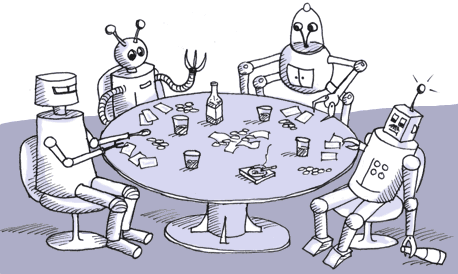
Here is John Devlin´s second-part posting on building his poker bot. Very interesting stuff, and if I ever do write the sequel to "Dirty Poker," which would of course be called "Dirty Poker 2," I will be asking Devlin for his participation in the chapter on online poker bots.
Devlin:
Last week, I posted about how I built a working, real-money online poker bot. This week, we'll discuss how to get started building your own bot, address some specific bot-building techniques, talk about the woeful state of online poker user privacy, respond to a few reader questions and comments, and close out with some recommended reading.
This series is both a detailed manual on how to build and make money with an online poker bot, and a story of how two guys from the Dallas poker underground managed to realize such a bot in practice.
We'll be discussing everything necessary to build what's quickly becoming the de facto standard in online poker botting: a sophisticated parallel processing rig incorporating collusion AI, massive hand history databases, and real-time information flow to dominate the opposition. This is where the world is headed:
NOTE: While I believe building and running an online poker bot to be neither cheating nor unethical, building a ring of such bots is a different story. As a long time poker-player, I absolutely don't condone cheating people out of their money by colluding in online poker or any other game. We're going to discuss things like bot collusion not so we can (all of us) go out and build colluding bot rings, but because these are the techniques people are using right now, today and tomorrow, to gain an unfair edge in online poker.
In order to build, or learn how to defeat, such a contraption, we're going to have to cover a lot of ground:
Artificial Intelligence. Neural nets, genetic algorithms, rules engines, decision trees.
Poker Strategy. Not the stuff you see on TV. Expert EV-driven poker strategy as it exists today, at the tables, in books, and on the forums.
Input Simulation. How to generate an appropriately timed and positioned stream of mouse moves, clicks, and keyboard input.
Operating Systems. Code injection, API hooking, kernel objects, multi-threading, DLLs. In general: forcing Windows to do what you want.
Reverse Engineering. How to reverse engineer poker client applications and the network data streams they rely on.
Probability and Statistics. Bayes Theorem, probability distributions, confidence intervals, and other goodies.
If you're new to poker, and particularly if you're new to programming, this will be a little bit of a trial by fire. Building a bot is basically the programmer equivalent of joining a Fight Club.
A guy who came to Fight Club for the first time, his ass was a wad of cookie dough. After a few weeks, he was carved out of wood.
Sort of. Read on.
Why are so many people interested in building bots?
Last weekend I got a phone call from a friend (a guy I'll have more to say about later), informing me that How I Built a Working Poker Bot, Part 1 had hit the front page of Digg, reddit, del.icio.us, and other sites, and that Coding the Wheel was getting enough traffic to occasionally throttle the server.
Since then, readers have posted upwards of a thousand comments to the story, here and around the net, and I've gotten a couple hundred emails ranging from technical diatribes to job offers to good old-fashioned hate mail.
The response has been unexpected. Thanks to all who took the time to read the first article, and to those who've joined the discussion so far. In hindsight it seems obvious, but many, many people have a vested interest in building, or discouraging the building of, software tools which emulate human behavior. It goes way beyond online poker, then again, in online poker the profit motive is compelling:
A successful online poker bot is worth hundreds of thousands of dollars even if all your bot does is break even. (I do not agree with this point) Sensationalistic? Maybe, but it's grounded in the very dull, non-sensational mathematics of rakeback and player promotions, which I've outlined below, and which we'll revisit in future posts.
Botting Rule #232: Wherever mouse clicks or other human-computer interactions are worth money, hordes of people will try to write software to simulate those interactions.
Why online poker clients are basically spyware
I want to preface this by saying: the online poker sites aren't evil. They're trying to protect their business, and that's perfectly normal. But I think they've strayed from the beaten path when it comes to respecting the privacy of their users.
Many online poker players have no idea that major poker sites silently install a browser plugin which has access to every page you visit in your browser, and potentially every piece of information on that page (the text of private emails; credit card numbers; user login information; etc):
Many online poker players have no idea that poker clients can and will snoop around on your system, potentially viewing sensitive data:
By examining your list of running processes
By reading body and titlebar text from every window you have open
By taking occasional screenshots
By snooping around on your file system, and in the system registry
By doing who knows what else, since there's zero oversight.
This is the definition of spyware. These "safeguards" constitute a basic invasion of your digital privacy and you should be angry about it. It doesn't matter whether the sites actually collect, pay attention to, store, or transmit that information. It doesn't matter if they do it with the best of intentions. It doesn't matter if they tell you they're going to do it in the EULA. They quite simply have no business doing it at all, and if they're going to do it, they should be doing a better job.
In other words, online poker is really the worst of both worlds: extreme invasion of privacy unheard of outside the realm of spyware, and zilch to show for it - zero effective safeguards against bots or other supposedly malicious software.
And yes: it's true that many sites will recognize well-known botting software such as WinHoldem. But they currently do very little in the way of preventing home-grown bots.
Botting Rule #472: The biggest advantage of a poker bot is its obscurity.
Using Spy++ or Winspector to get basic information from the poker client
Spy++ and Winspector are useful window analysis and debugging tools which allow you to view window properties and messages for any window in the system, including poker client windows:
Spy++ has extracted the handle (HWND), caption, class, style, location, and other properties of a Poker Stars table window. We can also drill down and find its child windows, parent window (if any), window class (PokerStarsTableFrameClass, in case you're curious) and other assorted information.
We can also use Spy++ to snoop on the exact messages received by a given window:
Spy++ is included in all versions of Visual Studio, as part of an MSDN subscription. Winspector has a larger feature set than Spy++ and is is available as a free download from http://www.windows-spy.com/.
Later, we'll be using this tool to help us figure out what the poker client is doing, beneath the hood. It's also an extremely useful all-purpose window debugging tool, and an important part of a bot developer's (or any Windows developer's) toolkit.
Why a bot doesn't have to win, in order to win
I've stated repeatedly that a poker bot only needs to break even in order to generate a profit. Here's how it works, for those who aren't familiar with rakeback or other online poker promotions:
IF you play X hands of online poker within a certain amount of time (such as a calendar year).
THEN the poker site gives you Y amount of money, or "player points" which are worth money.
That's a simplified, but otherwise accurate, description. And listen. Y can be very large, even "life-changingly" large. Let's look at some actual figures.
Consider that it's fairly standard for a (human) player to play 8 or even 12 tables simultaneously.
Furthermore, in online poker you're generally getting between 50 and 70 hands per table per hour. Let's call it 55, just to be conservative.
So that's 10 tables @ 55 hands per table per hour, for 10 hours a day, 6 days a week, 50 weeks a year.
If you do the math, you'll find it comes out to around 1.65 million hands per year. If your bot is playing anything other than the microlimits, this is easily enough to qualify you for (just as an example) the Poker Stars Supernova Elite promotion, which when properly liquidated is worth around seventy or eighty thousand dollars the year you achieve it, and two or three times that amount the following year (because of the multiplier effect of FPP bonuses).
Similarly, other sites offer rakeback promotions (~30% rakeback is fairly standard) along with assorted perks. If your bot is playing break-even poker, then your rakeback - quite substantial, as you move up from the microlimits - is pure profit. Ironically, your profit would shrink to zero if the site stopped collecting rake! (Update: a few readers have questioned this statement, claiming that a break-even bot with rake equates to a winning bot without rake. This is true, but the statement was tongue in cheek. It's ironic that a break-even bot ultimately ends up making money because of, rather than in spite of, the rake.) The thing that more than any other makes games tough to beat - the rake - makes it possible for your bot to turn a healthy profit. And that, as a long-time online poker player, makes me smile.
Botting Rule #1274: Many online poker sites would love to allow bots, if only their users would let them.
Botting Rule #47: Online poker players fear bots all out of proportion to the average bot's ability to win in competitive poker.
How to simulate human input (an overview)
In next week's post we'll cover this topic in detail, but for now: in order for your bot to be able to perform actions such as betting, raising, or folding, it needs to know how to talk to the poker client. There are at least three basic mechanisms you can use:
(Most difficult) Reverse-engineer the network protocol and communicate directly with the poker server.
(Somewhat difficult) Hook into the poker client just beneath the user-interface. In this scenario, you don't simulate mouse clicks; you figure out what internal function(s) handle those mouse clicks, and call those functions directly.
(Easy) Simulate user input - mouse clicks, keyboard input, whatever - at the operating system or even the driver level.
The first two techniques are mostly black magic. This third technique - user input simulation - can be further broken down into:
Using the SendInput API.
Directly generating and posting WM_MOUSEMOVE, WM_LBUTTONDOWN, and other messages to the poker window.
Using the (deprecated) keybd_event and mouse_event APIs.
Writing a custom mouse or keyboard driver.
Possibly other techniques..
And regardless of which method you use, you'll want to make it realistic:
By incorporating subtle timing randomizations.
By creating realistic mouse-movement trails.
By occasionally clicking and interacting with unrelated windows.
You'll find that the SendInput method offered the best tradeoff between power and ease of use, but this is a complex topic. I mean: the interactions between user input events and the various Windows subsystems are complex, and will require tweaking to get right. But the code to generate those interactions is fairly simple.
Why poker bots will soon be accepted as some of the strongest players in the world
In the first-ever Man vs. Machine Poker Championship, a University of Alberta research team lead by Dr. Jonathan Schaeffer (the guy behind Chinook, the program that effectively solved the game of checkers)...
...piitted the Polaris poker bot against famous poker professionals, Phil "the Unabomber" Laak and Ali Eslami.
Laak/Eslami won the match with 2 wins, 1 draw, and 1 loss. That's not a hugely convincing margin, and in fact, as the University of Alberta website points out:
The match was a success in many ways. Polaris proved that it was able to compete with some of the best poker players in the world. In fact, the 2-1-1 record of the humans is a little misleading. The actual difference in monetary outcome was just $395 which is a very small amount. The format of the match did a great deal to reduce the large variance in the game of poker, but it does not remove it all. The $395 sum could be as few as one or two hands where Polaris decided to fold when the human who got the same cards decided to continue. For this reason, a future match should prove particularly interesting, as the bot continues to develop in strength.
As for Phil Laak, he had this to say about Polaris, and about poker bots in general:
"We're already at the point where artificial intelligence crushes players that are unsophisticated, beats handily intermediate players, and loses small or wins small against savvy opponents... For Round 1, I'd say the bots have it.
Polaris's performance is reminiscent of the 1996 match in which world chess champion Gary Kasparov fended off the Deep Blue supercomputer, for the last time."
The IBM team responsible for Deep Blue made a few tweaks, and one year later, in 1997, Deep Blue came back and won a historic match, 3.5 to 2.5 (that's two wins, one loss, and three draws). Kasparov's allegations of unfair software-coaching practices were mostly ignored, and IBM never granted him a rematch. That caused some people to question the authenticity of Deep Blue's victory, for almost a decade.
Until 2006, when another chess program, Deep Fritz, handily beat world champion Vladimir Kramnik. The crucial difference between Deep Blue and Deep Fritz:
Deep Blue ran on specially designed supercomputer-grade hardware
Deep Fritz ran on a workstation PC with two Intel Core 2 Duo CPUs
For now I just want to make the point that intelligent, commercial-quality poker bots are a reality in the low and middle limits, and have been for a few years.
MSNBC: Are poker 'bots' raking online pots?
Wired: On the Internet, Nobody Knows You're a Bot
Coding Horror: The Rise of the Poker Bots
ThisIsMoney.co.uk: We put poker bots to the test...
Why DLL injection is so powerful
Several readers have stated that techniques like DLL injection are either a) overkill or b) likely to get you in trouble with the online poker sites. So I'd like to address this issue in a little more detail.
First, here's a video which demonstrates a simple, harmless use of DLL injection in practice: overwriting the Poker Stars cashier balance with a balance dreamt up by the user.
Inject the DLL
Subclass the Cashier window
Detect when the Cashier window is invoked
Override WM_PAINT and display a "fake" balance to the user
First, I recommended it earlier, and I'm going to recommend it again: Jeffrey Richter's excellent book on advanced Windows API development: Windows via C/C++. Buy it. Borrow it. Steal it if you must. Most of the information you'll find inside is available somewhere on the Internet, but you'll spend hours upon hours tracking it down. And nobody - nobody - speaks on this subject with Richter's authority.
Here are some thing to keep in mind when deciding whether or not DLL injection is for you:
DLL injection isn't a hack. It's a formal capability offered by the Windows API, without which hundreds of legitimate applications (ranging from computer-based training apps to instant messaging applications) would stop working.
There are at least 6 ways to inject a DLL (or binary) code into another process on Windows operating systems: 1) via the Registry 2) using Windows hooks 3) as a Debugger 4) with Remote Threads 5) by creating a Trojan DLL 6) CreateProcess/WriteProcessMemory.
DLL injection isn't particularly difficult to implement, and it's not a poorly-documented, error-prone procedure. It more or less just works.
A given poker client can't simply declare that all injected DLLs are evil. The operating system, as well as legitimate third-party applications, can both cause DLLs to be mapped into a process's address space. If Poker Stars, World of Warcraft, or whatever other application were to simply shut down whenever this happened, they'd be unusable.
While it's possible to detect when DLLs are injected into the process's address space, it's not possible to determine whether a given DLL is innocent or malicious. Sure, you can look for the DLL's name, but the name can be changed, with every invocation if need be. You can create some sort of checksum to try to identify malicious DLLs at the binary level. Again, easy to get around by creating a self-modifying .EXE.
That said, is it possible to create a bot without DLL injection? Absolutely. But if you can't get your code to run in the poker client's process, your powers are somewhat limited. For example, you won't be able to subclass poker client application windows. You won't be able to query various process data structures. You won't be able to intercept Windows messages intended for the poker client. And so forth.
Why screen-scraping is a bad idea
A lot of people have argued that some of the screen-scraping techniques I mentioned - such as pixel-testing for hole cards - are difficult to code, error-prone, and tedious to maintain. I couldn't agree more. Screen scraping is a last resort. The bot's Input Component needs to be structured such that it falls back on screen-scraping techniques only when all other options are exhausted.
That said, a mature bot capable of playing at multiple sites will probably require some sort of screen-scraping capability. The trick is to create a generic screen-scraping mechanism driven by XML or some other easily-edited format. That way, when some minor aspect of the poker client UI changes, all you have to do is update the "schema" for that particular online poker venue, without rebuilding the poker bot executables.
This will be the subject of (you guessed it) a future article.
Recommended Reading
This is by no means a complete list of recommended programming and/or poker books. However, all the books on this are a) relevant to building a poker bot and b) contain information which isn't readily available on the Internet, at least not without a good deal of sleuthing. I own a dog-eared, coffee-splattered copy of every book on this list, and have read most of them multiple times. Note: the programming books are coached from a C++ and Windows perspective but the techniques can be ported to other environments/languages.
Programming books:
Windows via C/C++. Jeffrey Richter. Everything you ever wanted to know about the Windows API. Should be required reading for all Windows developers, and for anybody working with .NET, as it addresses many of the API constructs on which .NET is built.
Exploiting Online Games: Cheating Massively Distributed Systems (Addison-Wesley Software Security Series). Greg Hoglund and Gary McGraw. If you actually plan on building an online poker bot, this is the book for you. Discusses many of the same techniques discussed in this series, but with a focus on World of Warcraft and other MMORPGs. All of the techniques discussed apply to poker, however.
Exploiting Software: How to Break Code (Addison-Wesley Software Security Series). Greg Hoglund and Gary McGraw. Companion volume to the above, with an emphasis on local applications (e.g., the poker client application running on your machine).
Poker books:
The Theory of Poker. David Sklansky. Quite possibly the most influential book in poker, written by the father of modern poker theory, David Sklansky. The value of this book is that it explains poker theory in a way that's universally applicable to all poker games. Required reading for all poker players and poker bot programmers.
The Mathematics of Poker. Bill Chen and Jerrod Ankenman. Difficult but extremely rewarding exposition of poker mathematics. In order to program a fluent poker AI you'll want to understand a lot, though not necessarily all, of this material.
Professional No-Limit Hold 'em: Volume I. Matt Flynn, Sunny Mehta, and Ed Miller. In my opinion this is the best book on no-limit Hold'em ever written, and the notion of planning hands around commitment and SPR squares very well with the poker bot AI we'll get into later.
No Limit Hold'em: Theory and Practice. David Sklansky and Ed Miller. Another excellent no-limit Hold'em book.
Gambling Theory and Other Topics. Mason Malmuth. A somewhat dry, rarely-read masterpiece, with some non-trivial mathematics. Not everything here is directly applicable to playing, or building software for, online poker, but it's all useful.
Getting Started in Hold 'em. Ed Miller. Introductory text. There are many good introductions to poker and to Texas Hold'em; this is one of the better ones, and introduces a short-stacked strategy that will be useful in deriving a competitive bot AI for real-money games, down the road.
Conclusion
We took a break from the source code in this installment as I don't want to alienate too quickly the readers who've subscribed in the past week. In the next installment, we're going to have to plunge right back in, beginning with an in-depth introduction to the architecture of the bot's AI component, expressed in C++, C#, or the language of your choice, and concluding with specific code you can use to simulate a realistic stream of human input. We'll also perform explorative surgery on various online poker clients, exposing their inner resources and code structures to the light of day. Last but not least, we'll answer the question of: how do I snoop on the poker client's log or hand history file in real time?
I will be looking out for Devlin´s next update in poker bot building and will blog it when it comes out.
Friday, May 23, 2008
Build Your Own Poker Cheating Bot!

HOW I BUILT MY OWN POKER BOT!
This article was written by James Devlin, who I do not know personally, but after reading his article on how he created his own winning online poker bot, I am quite impressed, and I agree with his declaration that poker bots are getting better and better and that soon online poker rooms will be populated more by poker bots than by legitimate online players. Remember, two years ago in my book "Dirty Poker," I made the statement that within a decade bots would account for more than 90% of online players. Add to that the rampant collusion play and you will have more than 99 percent of online poker players cheating!...unless of course some drastic changes occur in online poker.
Here is Devlin´s article, and I will have more on this tomorrow!
Several years ago, a client asked me to come up with a prototype for a real-money online poker bot. That's right: a piece of software you park on your computer while it goes out to a site like PokerStars or Full Tilt and plays no-limit Holdem for you, at 4 or 14 different tables, for real-money stakes.
If you're a poker player, and particularly if you're an online poker player, you've probably heard rumors about the rise of the poker bots. Unfortunately there's very little hard information out there (for obvious reasons) about how to build one of these bots. In fact, many so-called authorities still dismiss poker bots as a relic of the overactive poker player's imagination.
Well, I'm here to tell you that online poker bots are 100% real, and I know this because I've built one. And if I can build one, well. Anybody can build one. What's more, over the course of this multi-part article, I'll show you how.
That, ladies and gents, is a picture of a full-featured poker bot managing three play-money tables (note: this same bot also handles real-money tables) at an honest-to-goodness, real-money online poker site. Of course, it could be any site. The bot implementation I'm going to reveal will work at all major online poker sites, including Poker Stars, Full Tilt, Party Poker, Ultimate Bet, and most other major venues.
Why are you giving this information out?
I debated for a long time whether or not to make this information public, as I'm a poker player myself and have no desire to see the game ruined by an avalanche of poker bots. It's not that building a poker bot is some sort of black magic, known only to the privileged few. Any competent programmer can build one. But this information hasn't, so far as I know, been collected and presented in one place, certainly not as a "How To" complete with sample code. So the question I struggled with was this: is it irresponsible to publicize this information, such that every Internet script kiddie out there now has the ammunition he needs to actually build a bot?
After thinking about it, I've decided that keeping the technology of poker bot building secret is like declaring that only criminals can carry handguns. The fact is, there are people in the world right now who are doing this.
Poker bots, underground online poker boiler rooms, and collusion are a reality. That doesn't mean online poker's not worth playing, just that it pays to be educated about what's possible. Furthermore, there should be public discussion regarding what to do about it because one thing's certain: computers and programming languages aren't exactly going to be getting less powerful. The rise of the poker bots is a virtual certainty. I'd like to see the major online poker venues open up their famously vague "bot detection" and "anti-collusion" strategies to public scrutiny, as cryptography and security providers learned to do years ago. The best security algorithms and techniques all have the weight of public review behind them and I don't see how online poker's any different.
But even assuming all that weren't the case:
Poker bots already exist on the open market. Do a little creative Internet searching.
The poker community suffers from an irrational fear of bots. I'd gladly risk my money against most homegrown bots and trust me: you would too.
I believe that bots are actually good for the game of poker. Mike Caro, "the Mad Genius of Poker," expressed a similar idea years ago.
Any programmer worth his salt can build a bot with or without this document. They already have.
If you're visiting this page from 2 + 2 or another poker community, and you want to stay on top of this article (which will be in several parts), you can subscribe to the Coding the Wheel RSS feed or get it in your email inbox as I don't participate in these communities often. For easy digestibility, I'll be organizing these posts using a question and answer format, as there's a lot of highly technical material to cover.
Now, without further ado, let's talk about the basics. If you're not a programmer, fair warning: highly technical, possibly excruciatingly boring material ahead.
Basic poker bot responsibilities
At a very high level, the poker bot is best analyzed according to the classic model of information handling: Input, Processing, Output.
You'll find that your programming tasks decompose rather nicely into these three basic stages.
Input. The input to the system is the poker client software itself, including all its windows, log files, and hand histories, as well as internal (often private) state maintained by the running executable. The goal of the input stage is to interrogate the poker client and produce an accurate model of the table state - your hole cards, names and stack sizes of your opponents, current bets, and so forth.
Processing. The processing stage runs independently of the other two stages. It's job is to take the table model assembled during the Input phase, and figure out whether to fold, check, bet, raise, or call. That's it. The code that performs this analysis should (ideally) know nothing about screen scraping or interrogating other applications. All it knows is how to take an abstract model of a poker table (probably expressed as some sort of PokerTable class) and determine which betting action to make.
Output. Once the processing stage has made a decision, the Output stage takes over. It's tasked with clicking the correct buttons on the screen, or simulating whatever user input is necessary in order to actually make the action occur on a given poker site/client.
How does the bot figure out what its hole cards (and the board cards) are?
This is a broad question which it's better to break down into particulars. First of all, there's a very easy way to detect hole cards via a screen-scraping or "poor-man's OCR" approach. You don't have to be an image-recognition expert. All you have to know is how to get the color of a handful of different pixels on the screen. Or to put it another way, for any given card in the deck, there are a handful of pixels you can test which will uniquely identify that card.
That's fairly easy to implement, and requires zero knowledge of OCR, image recognition, graphics processing, etc. But depending on the specific poker site, pulling card rank and suit information might be even easier. On some sites, the hole cards will be emitted into the real-time game summary info:
Occasionally you'll find that hole cards are emitted into the log file. Poker Stars, for example, conveniently emits this information into its log file, and it does so in real time (meaning you can snoop on it in real time, and in the next installment, I'll show you how):
MSG_TABLE_SUBSCR_ACTIONMSG_TABLE_SUBSCR_DEALPLAYERCARDS sit1 nCards=2 sit3 nCards=2 sit5 nCards=2 sit6 nCards=2 sit7 nCards=2 dealerPos=3TableAnimation::dealPlayerCardsMSG_TABLE_PLAYERCARDS 00260C82::: 8s <-- Hole Card 1, Cool!::: 13c <-- Hole Card 2, Cool!Last but not least, hole cards are always included in the hand history for a given game:
*** HOLE CARDS ***
Dealt to CodingTheWheel [Qs 9h]
MargeLeb: calls 10
ke4njd: calls 10
diamondlover2nite: calls 10
franklg454: folds
WhoAmINot: calls 5
CodingTheWheel: checks
*** FLOP *** [4h 7c Qd]
WhoAmINot: checks
CodingTheWheel: bets 10
The only problem is that, in many cases, the hand history file isn't emitted until the end of the hand.
How should the poker bot be structured, as a single EXE, a bunch of DLLs, what?
You will need:
An executable file (.EXE) to display the bot's UI, and to contain the processing logic (the stuff that knows how to play poker).
A dynamic link library (.DLL) to handle the Input (screen scraping) and Output (clicking buttons) processing. You'll inject this DLL into the poker client's process so that your code is effectively running as part of PokerStars, or FullTilt, or whatever site you're using. This will make your life a lot easier both when it comes to collecting data as well as doing things like simulating genuine user input.
Those two pieces are essential. Other than that, you're free to structure things however you want. I'll have more to say on this as we get into the nitty-gritty details of the implementation.
How do I inject my code into the poker client process?
There are a number of well-documented techniques for injecting your code - for example, a DLL you've written - into another application's address space. The method I used, and the method I'm going to recommend you use, is by installing what's known as a Windows Hook and specifically a CBT Hook. The relevant Windows API is SetWindowsHookEx, and here's the actual source code. If you're familiar with C++ and the Windows API, it should be straightforward:
///////////////////////////////////////////////////////////////////////////////
// This is the CBT hook procedure. The HCBT_CREATEWND notification generally
// doesn't give us any useful information about the window because WM_CREATE
// hasn't been called for the window yet. So instead we don't consider the
// window as created until it's gotten it's first WM_ACTIVATE (note: this is
// how it works on Poker Stars, the behavior may need to be changed for other sites)
///////////////////////////////////////////////////////////////////////////////
LRESULT CALLBACK PokerBotCBTProc(int nCode, WPARAM wParam, LPARAM lParam)
{
if (nCode < 0)
{
return CallNextHookEx(g_hHook, nCode, wParam, lParam);
}
else if (theInjector.getVenue() != Venue_Unknown) // ignore this bit of code for now..
{
// Since we can't use DllMain, perform initialization the first time the hook is called.
if (g_bFirstTime)
{
theInjector.inject();
bFirstTime = false;
}
// These are the only notifications we're interested in passing on.
if (nCode == HCBT_ACTIVATE)
return (LRESULT) theInjector.HandleIt(Hook_Activate, (HWND)wParam);
else if (nCode == HCBT_CREATEWND)
return (LRESULT) theInjector.HandleIt(Hook_Create, (HWND)wParam);
else if (nCode == HCBT_DESTROYWND)
return theInjector.HandleIt(Hook_Destroy, (HWND)wParam);
}
// Return 0 to allow window creation/destruction/activation to proceed as normal.
return 0;
}
///////////////////////////////////////////////////////////////////////////////
// Publically exported hook installation function. The bot will call this on
// startup in order to inject this DLL (the DLL that contains this function)
// into the address space of every process, including every poker client process,
// on the machine.
///////////////////////////////////////////////////////////////////////////////
bool OPCHOOK_API InstallHooks()
{
// Actually install the hook...
g_hHook = SetWindowsHookEx(WH_CBT, (HOOKPROC) AutoCBTProc, hInstance, 0);
return g_hHook != NULL;
}
The above source code would live in a DLL: the DLL you plan on injecting into the poker client's address space. This DLL will also contain whatever code you write to handle the "input" (screen-scraping) and "output" (button-clicking) stages of the bot.
An even better way is to use a two-stage injection process. The problem with global CBT hooks (or any other kind of global hook for that matter) is that they cause the hook DLL to be loaded into the address space of every process on the machine. If your hook DLL is very fat (for example, if it contains a bunch of code to do screen scraping and so forth) this can impact system performance as your DLL will get mapped into processes you care nothing about, like Notepad.exe.
So to get around that, make the hook DLL - the DLL that gets loaded into every process - as lightweight as possible. Then, whenever the hook DLL detects that it's been loaded by a poker client process, such as POKERSTARS.EXE, have it explicitly load another DLL (again, written by you) containing the bulk of the bot I/O processing code. This in fact is the purpose of the theInjector object in the above code sample - it figures out if the DLL is being mapped into a poker client process and, if so, uses LoadLibrary to load the actual DLL that knows how to do things like screen-scraping and so forth.
Here, INJECT.DLL would be a lightweight DLL, written by you, which contains the CBT Hook procedure and installation code I showed you above. POKERBOT.DLL is the fat, messy DLL, also written by you, that contains the poker bot's screen-scraping logic.
Do things this way, and the drag on the system shouldn't even be noticeable, other than a brief load period when you first install the hook. This method is a lot easier than most other methods of DLL injection, and more importantly, it's supported across all the major Windows operating systems.
How do I retrieve the game summary text from the poker table window?
Almost every online poker client displays a small window in which game summary text is displayed.
Now, depending on which poker client you're using, this window may or may not be a standard Windows edit box or rich text control.
If it is a standard Windows control, you can get the handle (HWND) to the window, and then get its text via the GetWindowText API. Furthermore, you can do this even if the window you're interrogating is owned by another process.
But what you'll find is that many poker clients don't use "normal" Windows controls. They may write their own custom display controls, or they may subclass a standard Windows control and cause WM_GETTEXT to return an empty string.
In that case you have at least three options, none of them trivial:
You can investigate the control at the binary level. No matter how customized the control, somewhere in memory it's maintaining a string or a list of string which contains the game summary text. Since your code will be running inside the poker client's process, you're free to do whatever you want to do - investigate different areas of memory, subclass the control, etc.
You can use API hooking to hook the core Windows APIs that every control uses to display text: DrawText, ExtTextOut, etc.
You can use full-fledged OCR to analyze the text window and return the text. But this is probably overkill, especially since text tends to run through the summary window rapidly.
When building the bot, I went with the second approach: API Hooking. Once you know how to hook a particular Windows API, so that whenever POKERSTARS.EXE thinks it's calling DrawText, it's actually calling your custom version of DrawText, which snoops on the text before passing the call on to the original DrawText, it's a simple matter to examine the output coordinates to determine, aha: this text is being written to the summary window; this text is being written to the title bar; etc.
This is a deep enough topic that I'll roll it into its own installment along with specific code examples.
Hook a Windows API? Instrumentation? What does that mean?
Every Windows application in the world has to call into the Windows API to get things done: open files, create windows, display text, etc. Even language-specific libraries such as the C run time library or the C++ standard library internally will use the OS-provided facilities to work with things like files, memory, and so forth.
API hooking or "instrumentation" is the process of intercepting the function calls that an application (any application) makes, and redirecting them to a custom function defined by you. Specifically, you're going to intercept some of the calls that the poker application makes to the Windows API...
DrawText
ExtTextOut
WriteFile
etc
...and redirect these calls to a custom "interceptor" function, written by you. Your code thus gets a chance to examine the parameters of the call (which could be a string containing the player's name, for example) and do any other work you desire. When your "preprocessing" is done, you'll pass control back to the original API the poker application thought it was calling in the first place so that everything works transparently.
This technique can be used to extract all manner of useful internal information from any application, not just online poker clients. The best part is: you no longer have to write custom assembler code to achieve this. Instead you'll use a third-party library, and one of the best is a little-known Microsoft Research Project, Detours. Download it. Learn it. Love it. Learning how to accomplish API instrumentation means that ultimately, there's nothing the poker client can really hide from you - but that doesn't mean you'll be able to snoop around and figure out your opponent's hole cards. Don't even try. Unless the implementors have been sloppy, that information won't exist anywhere on your machine until your opponents have actually flipped their hole cards over.
And yes, if there's sufficient interest I'll put together a dedicated post with sample code showing exactly how to instrument a poker application.
Generally speaking, how do I go about harvesting data from an online poker game?
We've covered a few of the specifics so far, and we'll cover many, many more in future installments. But specific techniques aside, getting information from the poker client is an exercise in detective work. First of all, be aware of just how much information is available:
Visual Table State. Everything a human player sees when playing online poker: his hole cards; the names, stack sizes, and betting actions of all players at the table; the position of the button; and so forth..
Summary Text. Each table usually displays a text summary area which captures various betting actions, the beginning and end of new hands, etc.
Action Buttons. These are the buttons the user clicks in order to Fold, Raise, Call, etc. Note that we can use the presence or absence of various action buttons to infer table state.
Log File. Many poker clients output a log file which may contain helpful information.
Hand Histories. Most poker clients output a formal "hand history file" which contains a complete description of a single hand of poker.
Internal Stuff. Internally, most poker client makes standard calls to the C run-time library, the C++ standard library, and the Windows API. You can eavesdrop on these calls through a process known as API "hooking" or instrumentation. Additionally, poker clients, like all software, use memory to store things. Things like player names, cards, and betting actions.
And more. Stuff I may not know about, or may have chosen not to mention.
The bot's job is simply to eavesdrop on that information, and analyze it to produce an accurate model of the table's state at any given point in time. So any technique now or in the future which allows you to do that is potentially a technique you'll want to leverage in the bot. Later, I'll suggest an architecture whereby a number of different interrogators can be used to query poker tables in a simple, extensible, and above all tweakable way.
How do I create a bot that's intelligent enough to play winning poker?
That's the million-dollar question. I could tell you that the folks over at the University of Alberta's Computer Poker Research Group have made impressive headway towards producing a winning poker bot. I could tell you that extensible rules-based systems like the one I implemented for my bot...
...are a lot more powerful than you think. I could tell you a lot of things, and we'll investigate how to leverage some of the poker bot frameworks that are already out there, and how to combine those with your own custom rulesets. But understand one thing: you don't have to create a winning poker bot in order to make money with a poker bot. All you have to do is create a bot that's capable of breaking even.
If you can create a bot that breaks even - neither wins nor loses money - rakeback deals and specific programs like the Poker Stars Supernove Elite will ensure that you get a fairly hefty payday per bot account. I mean many tens of thousands of dollars per year, per account. And nothing except the logistical nightmare of it all restricts you to a single bot account; why not have ten; or a hundred?
And indeed, unbeknownst to the rest of the world, somewhere, someone probably does. But not me, and not you; and that's a disparity in basic firepower I'd like to see remedied, since none of the online poker sites have really stepped up to the plate and either a) made bots legal (similar to the way that they're legal on Internet Chess Club) or b) put effective prevention measures in place.
What skills will I need to write a bot?
Well, you'll want to be well-versed in the nuances of C++ and the Windows API, at a minimum.
In addition to that, you'll either need to be familiar with, or get familiar with, an assortment of Windows development topics that reads like a chapter out of Richter (whose books I highly recommend purchasing and studying if you plan on implementing a bot yourself).
Windowing & GDI
Windows Hooks
Kernel objects
DLL Injection (in general: the injecting of code into other processes)
API Instrumentation (via Detours or similar libraries)
Inter-process Communication (IPC)
Multithreading & synchronization
Simulating user input
Regular expressions (probably through Boost)
Spy++
While it would probably be possible to build a bot using C#, VB.NET, or any other language, you'll find that some of the powers you'll need are only available through specific Windows APIs, and getting access to these APIs from a managed language is a little clunky. Another reason you'll want to use native C++ is that you'll need to sneek some of your code into the client poker process, and it's a lot cleaner to inject a small DLL than it is to inject all the machinery necessary to get managed code to run inside another (native) process.
Conclusion
This post has only scratched the surface of building a full-fledged poker bot. Hopefully it's given you food for thought and possibly whetted your appetite for the mountain of details left to be discussed. Assuming there's sufficient interest, I'll be posting a series of installments, each describing at a detailed level how to accomplish one specific poker bot task. If you found this document through a link on 2 + 2 or one of the other poker forums, you can subscribe to this site in a reader or get it in your email inbox, as I rarely post (or reply) on the poker forums these days.
Wednesday, May 21, 2008
Pennsylvania Slot Machines Accused Of Being Rigged!

The State of Pennsylvania, brand new to legalized casino gambling and just getting its nose wet, is now getting its nose dirty as well, according to some reports in the news.
One form of casino cheating involves computerized slot machine spins to deceive players into thinking they almost had a jackpot, if only the spinning wheel in the last window had gone one more notch.
These near misses are not by chance, but are programmed into the computer to tantalize players who might otherwise be ready to give up. The "near miss" swindles are illegal in some places, but are legal in Pennsylvania. So the casinos, even though they are cheating, are not breaking the law!
Apart from all that, there is an even stronger reason to suspect rigged slot machines.
I know how film crews work, having made many TV shows about cheating in casinos and poker rooms. You probably have seen movie scenes or television spots depicting a joyous player winning a big jackpot.
Do you think movie or TV people will assign a film crew to watch that slot for 11 years, waiting for a jackpot? They will not. As soon as cameras roll, the casino's computerized system arranges that jackpot.
If they can arrange jackpots on cue, they can arrange other results when cameras are not rolling. If that is not a rigged system, I don't know what is.
Shame on Pennsylvania´s casinos!
Subscribe to:
Posts (Atom)

 Posts
Posts


